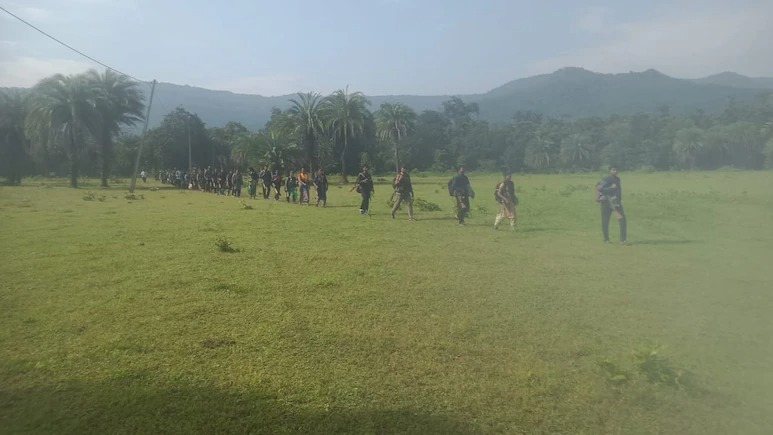
New Delhi: In one of the largest mass surrenders in recent years, 170 Maoists, including senior commander Rupesh, laid down their arms in Chhattisgarh on Friday, marking a significant setback for the insurgent movement in the state. The development follows another major surrender on Thursday, taking the total number of Maoists who have renounced violence in the past two days to 258 across Chhattisgarh and Maharashtra.
Rupesh, identified as the North-Western Sub-Zonal In-Charge and intelligence chief of the Maoist military wing, was among those who surrendered in Jagdalpur. His group, which included nearly 130 senior cadres among them a Central Committee Member, two DKSZC members, and 15 divisional-level leaders handed over a large cache of sophisticated weapons, including AK-47s, INSAS rifles, SLRs, and carbines. Officials said the surrender delivers a major blow to Maoist capabilities in southern Chhattisgarh.
Security forces had mounted a high-level operation to facilitate the surrender. The District Reserve Guard (DRG) and other units secured key routes from Uspari Ghat to Bhairamgarh, turning the area into a fortified zone to prevent any disruption. Senior officers coordinated the final handover in Bijapur.
Rupesh’s decision to surrender comes months after reports of internal dissent within the Maoist hierarchy. Once considered a hardliner, he was recently elevated to the Central Committee but had begun advocating peace talks earlier this year. His defection follows that of Politburo member Sonu alias Venugopal, whose surrender had already weakened the organisation’s leadership.
Officials hailed the development as a milestone in the ongoing campaign against Left-Wing Extremism. They said Abujhmad and North Bastar once strongholds of Maoist activity are now largely free of violence, with only isolated groups remaining in parts of South Bastar.
This year alone, Chhattisgarh has recorded historic progress against Maoist insurgency. A total of 312 militants, including eight senior leaders, have been killed in encounters, 836 have been arrested, and 1,639 have surrendered so far. The number of districts severely affected by Maoist violence has now fallen to just three—Bijapur, Sukma, and Narayanpur—signalling a decisive shift in the decades-long battle against extremism in the state.