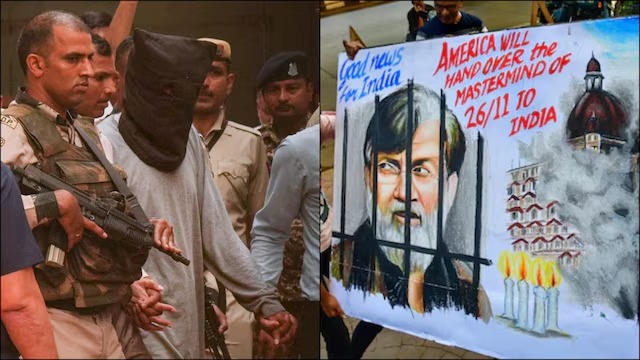
MUMBAI: In a major breakthrough in the ongoing investigation into the 2008 Mumbai terror attacks, Tahawwur Rana, a key accused recently extradited from the United States, has reportedly confessed to Indian authorities that he was a trusted agent of the Pakistan Army and played a direct role in conducting reconnaissance of targets in Mumbai prior to the 26/11 attacks.
Rana, who was brought to India on April 10, following the US Supreme Court’s rejection of his plea against extradition, is now facing trial for his alleged role in one of the deadliest terrorist attacks in Indian history. The Mumbai carnage, carried out by Lashkar-e-Taiba (LeT) operatives, claimed the lives of 166 people, including foreigners, and left hundreds injured.
While in the custody of the National Investigation Agency (NIA), Rana was interrogated by the Mumbai Police Crime Branch, during which he made several startling admissions. Most notably, he admitted to being a trusted operative of the Pakistan Army, revealing that his connection with the military dates back to his deployment in Saudi Arabia during the Gulf War.
He further revealed that Lashkar-e-Taiba, the Pakistan-based terror outfit behind the Mumbai attacks, was initially formed as an espionage network. He also confirmed that his close associate David Headley, a Pakistani-American terrorist and LeT operative, conducted several terror training sessions with the group and helped identify strategic targets in Mumbai.
Perhaps the most damning revelation is Rana’s own admission that he had conducted reconnaissance missions across Mumbai and was present in the city during the 26/11 terror attacks, particularly when terrorists struck the iconic Taj Mahal Palace Hotel, one of the primary targets.
These confessions solidify India’s long-held position regarding Pakistan’s military establishment’s involvement in the planning and execution of the attacks, especially through its proxy terror networks like LeT.
Rana’s judicial custody was extended till July 9 by Delhi’s Patiala House Court during a recent hearing, where he was produced via video conference. The court also granted him limited communication privileges, allowing him to make a single phone call to his family, following approval from the NIA and jail authorities.
The NIA has formally charged Rana for conspiring with David Headley, who had earlier confessed to his role in scouting locations for the attack. Rana is accused of helping Headley obtain a visa to India under a false identity, thereby enabling him to conduct the surveillance essential for planning the massacre.
With Rana’s latest confessions, the case has once again put the spotlight on Pakistan’s alleged state-sponsored terrorism. His claims add to the growing dossier of evidence linking Pakistan’s intelligence agencies and military structures with terror outfits like LeT, which continue to pose a serious threat to regional and global security.
As the NIA continues its probe, India may use Rana’s confession to further press its case against Pakistan at international forums, demanding accountability and dismantling of terror infrastructure operating under official protection.
Sorry, there was a YouTube error.