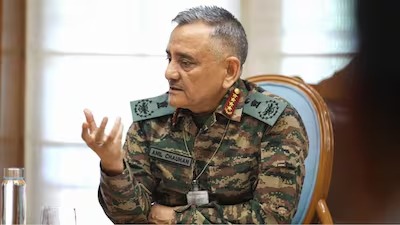
New Delhi: Chief of Defence Staff (CDS) General Anil Chauhan has revealed why India launched Operation Sindoor the massive retaliatory strike on terror camps in Pakistan and Pakistan-occupied Kashmir (PoK) shortly after midnight on May 7.
Speaking at an event in Ranchi on Thursday, General Chauhan said the strikes, conducted between 1:00 and 1:30 am, were timed to ensure maximum precision while minimising civilian casualties.
“Why did we strike at 1:30 at night? That is the darkest time, the most difficult time to get satellite images, photographs, and collect evidence. Yet, we struck at that time for two reasons we had confidence in our ability to get imagery even at night, and we wanted to avoid civilian casualties,” the CDS explained.
He said that while the ideal time for such strikes is between 5:30 and 6:00 am, civilian movement is high at that hour due to early morning prayers. “At that time, the first azaan takes place. In Bahawalpur and Muridke, there could have been heavy civilian presence, and many could have been killed. We wanted to avoid that,” he said.
General Chauhan said the date of the strike was determined after analysing Pakistan’s flight activities post-April 23 and factoring in favourable weather forecasts predicting clear skies for several days.
Unlike earlier operations like Uri and Balakot, Operation Sindoor involved all three services of the Indian Armed Forces. The Navy was deployed in Jammu & Kashmir and Punjab, while the Air Force and Army carried out precision strikes using loitering munitions, drones, and air-launched weapons.
“These loitering munitions have a range of 30–40 km, and we knew Pakistan did not have the capability to intercept them,” Chauhan said. He added that for certain deep targets like Bahawalpur, which was 120 km away, the Air Force was used to ensure accuracy.
The May 7 strikes were carried out in retaliation for the April 22 Pahalgam terror attack, in which 26 tourists were gunned down by Lashkar-e-Taiba terrorists. India hit at least nine terror strongholds, including Lashkar’s headquarters in Muridke, Jaish-e-Mohammed facilities in Bahawalpur, and Hizbul Mujahideen bases in Sialkot, killing over 100 terrorists including 10 family members of JeM chief Masood Azhar and four of his close aides.
The Indian Air Force later confirmed that its air defence systems shot down five Pakistani fighter jets and a specialised airborne surveillance aircraft (AEW&C/ELINT).
Addressing students at the same event, General Chauhan urged young Indians to consider careers in the armed forces, calling the military the “only place where there is no nepotism.”
“You should aspire to join the armed forces if you want to serve the nation and explore the country and the world,” he said, adding that the armed forces had worked tirelessly this year to rescue citizens during natural disasters.
General Chauhan concluded by underlining that the success of Operation Sindoor was the result of meticulous planning, reconnaissance, and inter-service coordination.