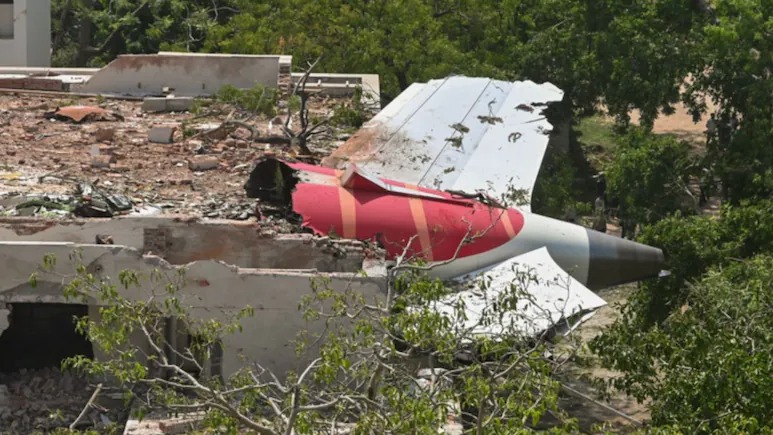
New Delhi: More than two weeks after the tragic crash of an Air India Boeing 787 Dreamliner in Ahmedabad that killed 241 of the 242 people on board, investigators and the airline are exploring the possibility of a dual engine failure as a contributing factor to the disaster. In a significant development, Air India pilots have conducted a simulated reenactment of the doomed flight in an effort to better understand what went wrong.
According to sources familiar with the matter, the airline’s pilots recreated the flight’s conditions in a simulator — replicating key parameters such as landing gear deployment and retracted wing flaps. The results showed that these configurations alone were not enough to cause a crash, suggesting a technical malfunction may have played a larger role.
The findings from this simulated test add weight to an earlier discovery: that the aircraft’s emergency power unit, a small Ram Air Turbine (RAT), had deployed just seconds before the crash. The RAT is only activated in cases of severe electrical failure, pointing once again to a possible loss of power from both engines. The aircraft involved in the crash, a Boeing 787 Dreamliner, was powered by two General Electric engines.
Video footage of the June 12 crash showed the plane struggling to climb immediately after takeoff before losing altitude and crashing back to the ground in a fiery explosion. The investigation, led by India’s Aircraft Accident Investigation Bureau (AAIB), is examining multiple possible causes, but sources say the focus has now shifted to potential technical or mechanical issues, particularly with the engines or power systems.
While Boeing has declined to comment and referred all queries to the AAIB, and General Electric has said it cannot comment on an active investigation, sources indicate that data from the aircraft’s two flight recorders — the cockpit voice recorder and the flight data recorder — have been successfully extracted and are currently under analysis.
Experts involved in the investigation are also scrutinizing additional clues from the crash footage. Notably, the aircraft’s landing gear appeared to be partially tilted forward, possibly indicating that the pilots had begun retracting the wheels. However, the landing gear doors remained closed, which some aviation experts suggest could signal a hydraulic or electrical failure — both of which are powered by the aircraft’s engines.
Modern aircraft engines are managed by an advanced computer system known as Full Authority Digital Engine Control (FADEC), which automatically controls engine parameters to ensure efficient performance. If both engines experienced a simultaneous failure — a rare and catastrophic event — the system could have failed to respond in time.
The emergency deployment of the RAT provides a critical clue. Though it can temporarily supply electricity to essential systems during a power loss, the RAT cannot generate thrust or lift, meaning the aircraft would still have been incapable of staying airborne without engine power.
Investigators also confirmed that the wing flaps and slats, which increase lift during takeoff, were extended as expected, further supporting the theory that the crash wasn’t due to pilot error or configuration mismanagement.
This crash is the worst air disaster in Indian civil aviation in decades and marks the first-ever loss of a Boeing 787 Dreamliner due to an accident. The pilots had issued a Mayday call just seconds after takeoff, and investigators estimate that only 15 seconds elapsed between the distress signal and the crash, leaving virtually no time for recovery or corrective action.
Teams from Boeing and the US National Transportation Safety Board (NTSB) are assisting the AAIB in the ongoing investigation. However, it remains unclear when an official update will be released based on the flight recorder data, which could provide key insights into what happened in the final moments — including cockpit conversations, systems performance, and engine behavior.
As the investigation progresses, authorities are expected to release a preliminary report in the coming weeks, though a full analysis and final report may take several months. For now, the aviation world watches closely as experts work to uncover the cause of a tragedy that has shaken confidence in one of the world’s most advanced passenger aircraft.
Sorry, there was a YouTube error.