New Delhi: Amid escalating trade tensions with the United States, the Indian Army has thrown a sharp reminder of past geopolitical frictions, posting a historical reference to Washington’s long-standing support to Pakistan. The move comes just a day after former US President Donald Trump threatened to impose steeper tariffs on Indian goods over the country’s continued purchase of Russian oil.
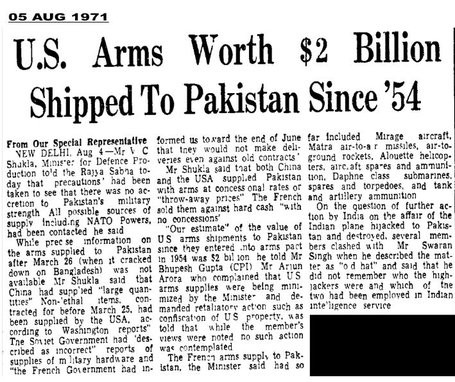
In a pointed social media post on Tuesday, the Indian Army’s Eastern Command shared a newspaper clipping dated August 5, 1971 — a pivotal moment in the build-up to the Indo-Pak war that led to the liberation of Bangladesh. Captioned “This day, that year – build-up of war – August 5, 1971”, the post served as a reminder of America’s strategic tilt towards Pakistan during the Cold War era.
The clipping cites the then Defence Production Minister, V.C. Shukla, addressing the Rajya Sabha on the flow of foreign arms to Pakistan. At the time, he stated that while NATO powers and the Soviet Union had been approached over the issue, it was the United States that continued to arm Pakistan. France and the Soviet Union reportedly denied selling weapons to Islamabad, but the US remained a consistent supplier.
The report further revealed that both the US and China were selling arms to Pakistan at “throwaway prices” — highlighting that much of Pakistan’s military strength during the 1971 conflict was built on weapons provided by the two global powers.
The Indian Army’s throwback came in the wake of renewed threats from Donald Trump, who on Monday took aim at India over its Russian oil dealings. In a post on Truth Social, the Republican leader warned of “substantially raising the tariff paid by India to the USA”, claiming that India was not just buying Russian oil but also reselling it on the global market for significant profits.
“India is not only buying massive amounts of Russian oil, they are then, for much of the oil purchased, selling it on the open market for big profits. They don’t care how many people in Ukraine are being killed by the Russian war machine,” Trump said, adding that retaliatory tariffs were imminent.
Ironically, Trump’s threat coincided with a new executive order he signed, which increased tariffs on dozens of countries — but lowered tariffs on Pakistan, from 29% to 19%. The move raised eyebrows in New Delhi, especially against the backdrop of Washington’s aggressive stance toward India’s independent energy policy.
India’s Ministry of External Affairs responded swiftly and assertively, accusing critics of hypocrisy. In an official statement, the government reminded the world that when India began oil imports from Russia following the Ukraine conflict, it did so with the full encouragement of the United States.
Further, India called out the selective outrage by countries like the US and members of the European Union, highlighting that their own trade with Russia continues at far greater volumes than India’s.
According to the ministry:
• The European Union had bilateral goods trade with Russia worth €67.5 billion in 2024.
• Services trade between the EU and Russia stood at €17.2 billion in 2023.
• European imports of Russian LNG reached a record 16.5 million tonnes in 2024, up from 15.21 million tonnes in 2022.
India emphasized that its energy imports from Russia were a “necessity compelled by global market conditions”, not a geopolitical choice. In contrast, Western nations have continued business-as-usual with Russia even when such trade was “not even a vital compulsion.”
India also listed a wide array of goods traded between Europe and Russia, including fertilizers, mining products, chemicals, iron, steel, machinery, and transport equipment — underscoring the scale and diversity of the West’s ongoing commercial engagement with Moscow.
The Indian Army’s 1971 throwback can be interpreted as a subtle yet strong message — underscoring the continuity of US policy that often sidelines Indian security concerns. At a time when Washington is again seen as favouring Pakistan economically, and targeting India for pursuing its sovereign trade interests, the Army’s post seeks to remind the public and the global community of historical parallels.
This is not the first time India has used history as a diplomatic tool. But for the armed forces to weigh in publicly, even symbolically, reflects the growing strain in India-US ties over what New Delhi perceives as unfair treatment and double standards.
As the global power balance continues to shift, India is increasingly asserting its strategic autonomy — unwilling to be lectured or coerced, especially by those with inconsistent records themselves.
With trade wars threatening to escalate, historical memories resurfacing, and diplomacy entering a more defiant phase, New Delhi seems set to chart its own course — grounded in national interest and global realism.
The Indian Army’s social media post, more than a mere history lesson, may well be a signal of the country’s unwillingness to forget — or forgive — past transgressions.