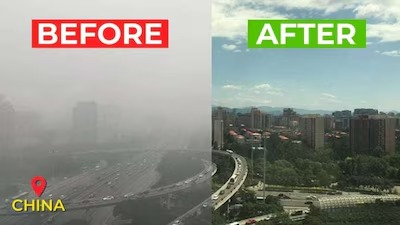
New Delhi: With Delhi’s air quality once again slipping into dangerous territory, a spokesperson from the Chinese Embassy has shared how China managed to reverse years of severe pollution and achieve rapid improvements in urban air quality. The remarks came through a series of posts on X, drawing attention to China’s experience at a time when India is grappling with recurring winter smog.
Yu Ying noted that China had also faced prolonged periods of hazardous pollution, with several of its major cities previously listed among the world’s most polluted. She said China eventually brought down pollution levels through continuous policy action, strict enforcement and technological support. The first post, shared on Tuesday, featured contrasting images of Chinese skylines covered in grey haze compared with later pictures showing visibly clearer skies. She wrote that China once struggled with smog and expressed confidence that India could also achieve similar progress.
In a detailed follow up message on Wednesday, Ying outlined the measures that contributed to China’s turnaround. These included phasing out smaller and inefficient coal based boilers, shutting or relocating industrial units with high emission footprints, and introducing tighter emission norms for both heavy industries and vehicles. She also highlighted the expansion of renewable energy, real time monitoring with satellite data and firm penalties for violations, including cases of falsified records.
Her comments come at a time when Delhi’s air quality remains a matter of public concern. According to the Central Pollution Control Board, the city recorded an AQI of 202 on Wednesday, following readings of 291 and 309 earlier in the week. These levels fall in the poor to very poor range, prompting advisories for residents to limit exposure, especially those with respiratory or cardiac conditions.
Forecasts indicate that air quality in the region is likely to worsen between 6 and 8 November. Authorities have urged people to take preventive measures as seasonal weather patterns and local pollution sources continue to affect visibility and health across the national capital region.