Team Goemkarponn
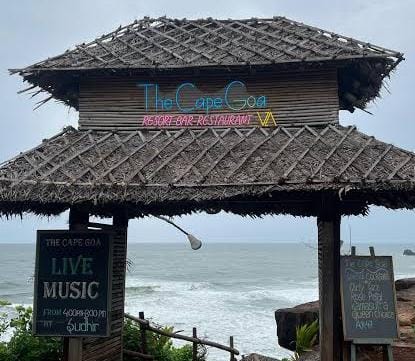
CANACONA: In a continued enforcement drive following the deadly Arpora nightclub blaze that killed 25 people, authorities on Monday ordered the immediate sealing of the popular seaside establishment ‘The Cape Goa’ at Cabo de Rama in Canacona, citing serious safety violations and grave risks to public safety.
The closure order was issued ex-parte by Maya Pednekar, Executive Magistrate and Chairperson of the Joint Enforcement and Monitoring Committee (JEMC), Canacona, without prior notice to the establishment. The decision, the order stated, was taken in view of the imminent and immediate threat posed to human life and property.
“After examining the inspection report and materials placed before me, I am convinced that the risk is real, immediate and severe. The premises are being operated in a manner that endangers public safety, warranting urgent intervention to protect life and property,” Pednekar said in her order.
The action followed an inspection conducted by the JEMC at ‘The Cape Goa’, located at Kuddi, Cabo de Rama, on December 12 at around 12.25 pm. During the inspection, the committee found that the establishment was functioning in what it described as blatant violation of mandatory statutory safety norms.
According to the order, the premises were overcrowded, with more than 24 persons present, far exceeding permissible limits. The management failed to produce an approved structural plan or a structural stability certificate. Inspectors also flagged the kitchen as unsafe, noting the absence of a proper exit and the presence of high fire-risk conditions.
The pantry area was found to have no exit, posing a serious hazard in case of an emergency. A total of 29 commercial LPG cylinders were discovered stored in the open, close to an exhaust blower and duct, a situation described as extremely dangerous. The lack of a designated LPG bank and the absence of gas leak detectors were cited as posing an immediate risk of fire or explosion.
The order further noted that there was no separate exit from the restaurant area, while fire extinguishers and other firefighting equipment were missing across multiple sections, including the seating area, kitchen, pantry, storerooms, bakery and areas located below the restaurant. Entry and movement routes were obstructed, cooking ranges were placed along movement paths, and there was no signage indicating exits, escape routes or assembly points.
Inspectors also observed that the exit was blocked by LPG cylinders and that the MCB distribution board was left open and unsafe, with loose electrical connections and hazardous wiring throughout the premises.
Pednekar pointed out that while the Tourism Department had granted permission only for a single temporary private shack measuring 8×18 metres in Survey No. 269/2, the establishment was operating as a full-scale restaurant far beyond the approved limits. The expanded operations included a bar counter, kitchen, bakery, pantry, staff mess catering to nearly 120 staff members, staff accommodation in the basement, approximately 40 tables with seating for about 120 guests, as well as multiple ancillary rooms.
The order also noted that slope cutting had been carried out in a No Development Zone (NDZ), allegedly in violation of the Coastal Regulation Zone (CRZ) Notification. Additionally, the owner or occupier failed to furnish essential documents such as the construction licence, occupancy certificate, trade licence, TCP clearance and other mandatory statutory approvals.
In light of the cumulative violations and risks identified, the committee ordered the immediate sealing of the entire premises, marking one of the strongest enforcement actions taken so far in the wake of the Arpora tragedy.