By Team Goemkarponn | Panaji
Every monsoon, as Goa’s hills turn lush and rivers surge, a silent crisis returns. Behind the beauty lies a grim reality: inland waterbodies become deadly traps—claiming lives year after year, despite repeated warnings, barricades, and tragic headlines.
Between 2019 and 2024, at least 113 people drowned in Goa’s inland waterbodies, official records show. These deaths happened in rivers, waterfalls, ponds, irrigation canals, and abandoned stone quarries. Authorities say more than 65% occurred during the monsoon, when currents become unpredictable and depths rise overnight.
While beaches have professional lifeguards, most of these inland sites remain unguarded—and many are officially closed to the public in monsoon months. Yet, people keep venturing in, often ignoring the rules and paying the ultimate price.
Quarries and Dams: A Hidden Peril
Some of the most dangerous sites are the abandoned quarries that dot Goa’s hinterland. In the last five years alone, 26 quarry drownings have been reported—many of them teenagers and college students who thought a flooded pit was a safe place to swim.
In July 2024, a Class XII student slipped into Sonsodo quarry while taking photos with friends. “He was with classmates. One minute he was laughing, the next he was gone,” said a local resident who helped retrieve the body.
Police say these quarry deaths follow the same pattern: no fencing, no depth markers, no supervision. “Quarries look calm but are deeper than most people realise,” said an officer in Margao. “Kids think it’s rainwater. They jump in and don’t come back.”
Dams and irrigation canals have also claimed lives. In August 2022, a tourist drowned in a canal near Salaulim dam during high discharge. In 2021, a man was swept away near Anjunem dam. A Fire Services official described them as “death zones” when the water releases start.
Rivers and Waterfalls: Monsoon Turns Deadly
Tourists drawn by Instagram reels and travel blogs flock to Goa’s waterfalls—Dudhsagar, Arvalem, Kuskem—without understanding how quickly a trickle becomes a torrent.
June 2024 saw two students from Pune drown in a Mandovi tributary while taking selfies. “They were just knee-deep, but the water rose to their chest in five minutes,” a local rescuer recalled.
Records show 58% of drowning victims are tourists, mostly from Maharashtra and Karnataka, while 30% are Goans, often young people treating flooded ponds or streams as playgrounds.
Restrictions Ignored: “Picnics Are More Important Than Lives”
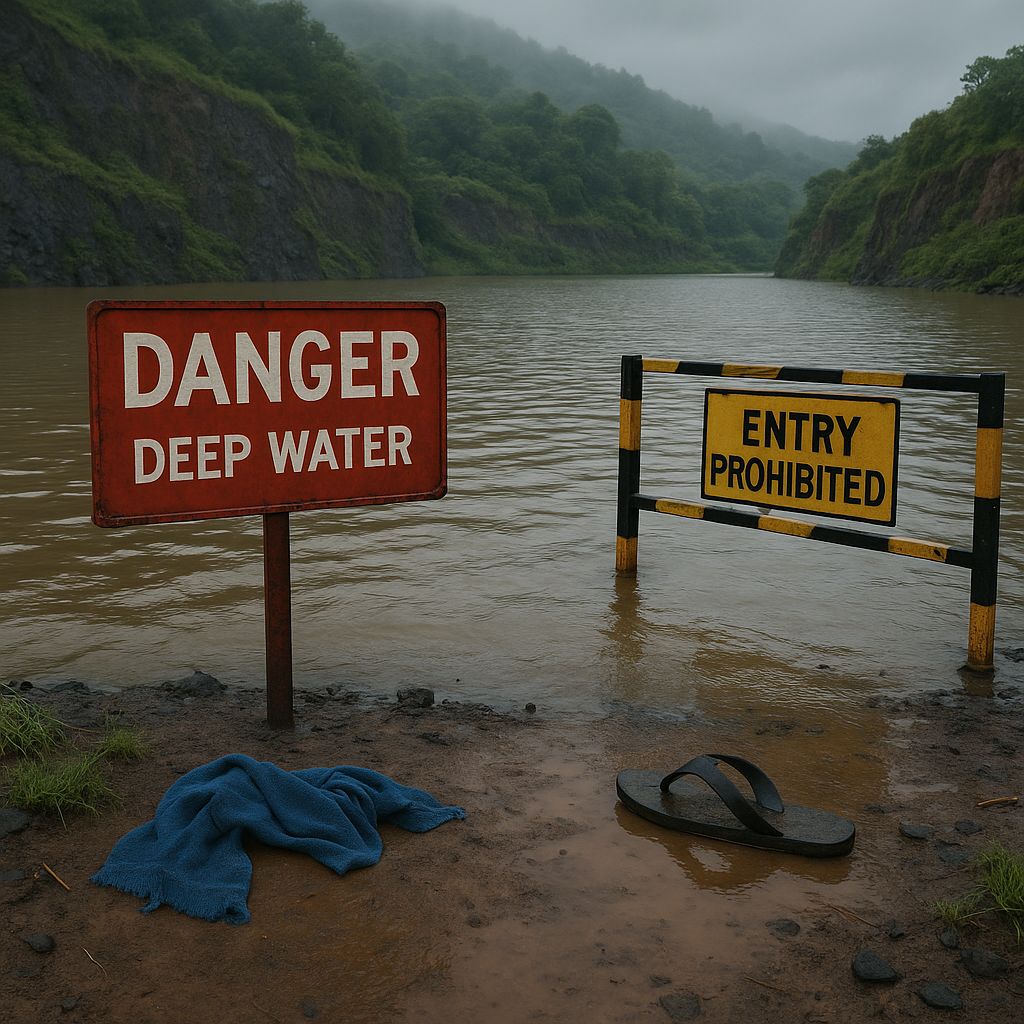
What frustrates officials most is that many of these places are officially closed during monsoon. Temporary barricades, caution boards, and fencing are set up every June. But enforcement often falls short—not because of apathy, but because people refuse to follow the rules.
“We put ropes and signs saying ‘No Entry’ in big letters,” said a police inspector in Sanguem. “Still, families come with picnic baskets. Teenagers climb over fences. For them, the thrill is more important than safety.”
A Fire Services officer described similar scenes near quarries. “We get calls from locals saying, ‘There are boys swimming again.’ By the time we reach, it’s too late.”
Locals say they warn visitors all the time. “They laugh and say, ‘Nothing will happen to us.’ Then tragedy happens,” said a panchayat member near Collem quarry.
No Central Monitoring, Few Consequences
RTI queries filed by NGOs show no single agency is responsible for monitoring all inland water sites. The Mines Department says quarries are the collector’s responsibility. The Irrigation Department manages dams. The Tourism Department says inland safety is outside their jurisdiction.
“There is no budget, no central reporting, no accountability,” said a social worker who has filed multiple RTIs. “And so, year after year, we count the dead.”
Sorry, there was a YouTube error.