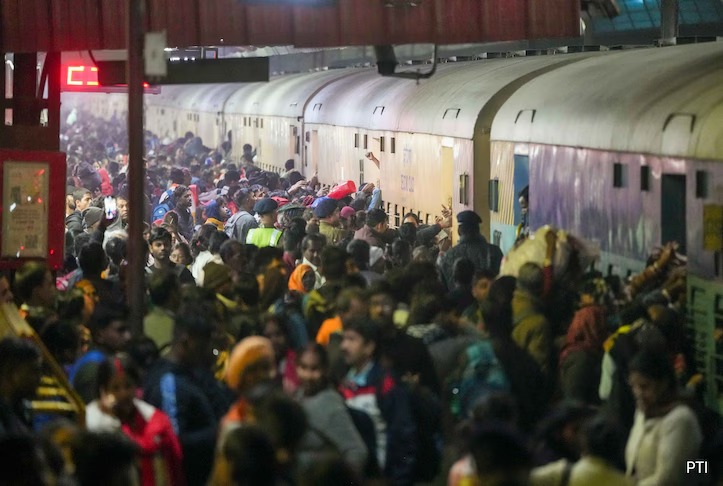
New Delhi: A tragic incident that claimed 18 lives and injured 15 others at New Delhi Railway Station earlier this year was triggered by a large headload that fell from a passenger, leading to a chain reaction on a crowded foot overbridge, the Railway Minister revealed during a recent Parliament session.
Responding to a query in the Rajya Sabha, the Railway Minister shared key findings from a high-level inquiry committee set up to investigate the February 15 incident. According to the minister, the accident occurred when a large headload being carried by a passenger fell, causing others on the staircase of platforms 14 and 15 to trip. The resulting domino effect caused passengers to fall on each other, leading to multiple casualties.
On the day of the incident, the station was experiencing an unusually high surge in footfall due to the Maha Kumbh Mela in Prayagraj. Approximately 49,000 general tickets were sold — 13,000 more than the daily average — contributing to increased congestion on the foot overbridge (FOB).
The minister stated that although crowd management measures were in place, passenger density on the bridge started rising steadily after 8:15 p.m. At 8:48 p.m., the situation turned tragic when a headload fell and triggered a panic-induced fall, particularly near FOB-3. The situation was worsened by many passengers carrying heavy loads, which hampered movement on the bridge.
While earlier reports described the event as a stampede, the minister’s statement avoided using the term, instead referring to it as an “incident” caused by tripping and crowd pressure.
Families of the deceased were given ₹10 lakh as compensation, while ₹2.5 lakh was awarded to those seriously injured and ₹1 lakh to those with minor injuries. In total, ₹2.01 crore has been disbursed to 33 affected individuals and families.
In response to the tragedy, the railways have introduced several crowd control measures to prevent similar incidents in the future. These include the development of permanent holding areas, controlled entry for confirmed ticket holders at 73 stations, the construction of wider foot overbridges, deployment of CCTV surveillance, and setting up of control war rooms at major stations.
The incident has highlighted the urgent need for improved infrastructure and proactive crowd management, especially during large-scale religious gatherings and peak travel seasons.
Sorry, there was a YouTube error.