Team Goemkarponn
PANAJI: The Bharatiya Janata Party (BJP) remained the single largest force in the Zilla Panchayat elections, winning 29 seats and topping the vote share chart with 2,50,149 votes, accounting for 40.63 per cent of the total votes polled. However, the results mark a clear setback for the ruling party, with its seat tally slipping from 33 in 2020. Even with alliance partner Maharashtrawadi Gomantak Party (MGP), the BJP-led combine could muster only 32 seats, still short of the BJP’s standalone performance five years ago.
The erosion was most evident in six constituencies — Aldona, Sirsaim, Betqui-Khandola, Davorlim, Guirdolim and Khola — where the BJP failed to retain seats it had earlier won. All but one of these seats were captured by the Congress, which emerged as the principal beneficiary of the BJP’s decline. Betqui-Khandola was won by an independent candidate.
Two of these defeats proved particularly embarrassing for the ruling party, as they came in constituencies represented by sitting BJP MLAs Nilkhant Halarnkar and Govind Gaude. The results point to the party’s inability to translate Assembly-level influence into Zilla Panchayat victories, highlighting a disconnect between leadership and voters at the grassroots level, where local issues often outweigh state or national narratives.
The BJP also faced disappointment in Colvale, represented by sitting MLA Nikhant. Although the Colvale ZP seat had never formally been with the BJP, the party was widely seen as being in a strong position to wrest control this time. Its failure to do so underlined organisational weaknesses and ineffective local mobilisation. Sitting ZP member Kavita Kandolkar, wife of former BJP MLA Kiran Kandolkar, retained the seat.
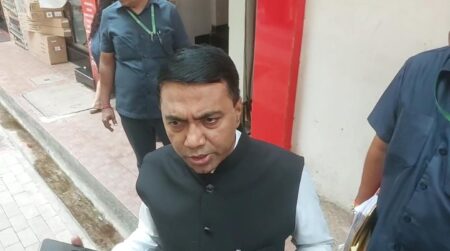
Admitting that the results were a setback, Chief Minister Pramod Sawant said the party would undertake a detailed assessment and take corrective steps going forward.
In contrast, the Maharashtrawadi Gomantak Party appeared to have held its ground. After contesting independently in 2020 and winning three seats, the regional party retained all three seats in the current elections. While this provided numerical stability to the BJP-led alliance, it also underlined that the BJP’s losses were not offset by gains from its partner.
The vote share figures present a nuanced picture. The Congress, despite finishing a distant second in overall votes with 1,16,565 votes (18.93 per cent), converted its support effectively in constituencies where the BJP lost ground, enabling it to register key victories. Among regional players, the Revolutionary Goans Party (RGP) polled 56,331 votes (9.15 per cent), while the Aam Aadmi Party (AAP) secured 32,995 votes (5.35 per cent). The Goa Forward Party (GFP) followed closely with 30,573 votes, accounting for 4.96 per cent of the total vote share.
Political observers noted that while the BJP’s dominant vote share reflects its continued statewide influence, the fragmentation of the opposition vote among Congress, RGP, AAP, GFP and independents shaped constituency-level outcomes. At the same time, the Congress’s ability to capitalise on BJP’s local setbacks allowed it to punch above its overall vote share.
A comparison with the 2020 Zilla Panchayat elections is telling. Then, the BJP had secured a commanding 33 seats on its own, reinforcing its dominance across rural and semi-urban Goa. Five years later, the reduced tally suggests voter dissatisfaction over local governance, delivery of basic services and representation — areas where Zilla Panchayats play a critical role.
While the BJP continues to retain numerical strength and the advantage of incumbency at the state level, the ZP verdict serves as a warning. The erosion of support in traditional strongholds and MLA-represented areas indicates that the party can no longer rely solely on leadership stature or alliance arithmetic, and must urgently address grassroots concerns to arrest further decline.