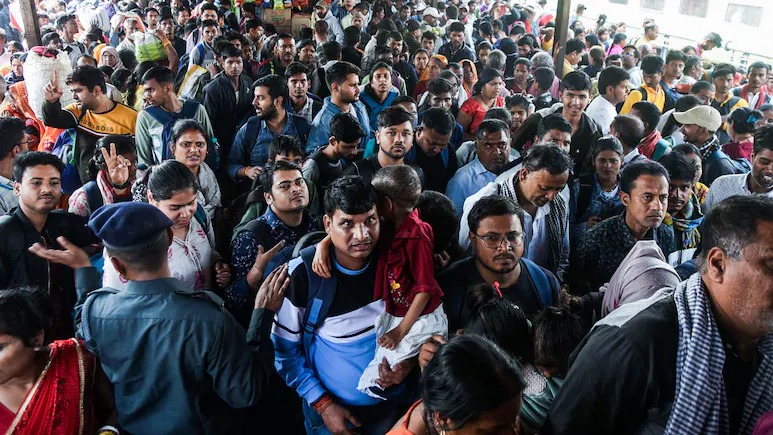
New Delhi: In a significant development, the Government of India on Monday issued the official notification to begin the long-awaited population Census, which will now be conducted in two phases starting in the Union Territories of Ladakh and Jammu & Kashmir, along with Himachal Pradesh and Uttarakhand, from midnight of October 1, 2026. The rest of the country will see census operations commence from March 1, 2027.
This will mark India’s first national headcount in 16 years, as the 2021 Census was postponed due to the COVID-19 pandemic. The last census was held in 2011, and the delay has been a key issue of contention among opposition parties who have pressed the Centre for an updated and comprehensive enumeration.
The announcement came shortly after Union Home Minister Amit Shah held a high-level review meeting in Delhi. He was joined by the Home Secretary, the Registrar General & Census Commissioner of India, and other top officials to assess the preparations and roadmap for the massive national exercise.
Two-Phase Census Plan
As per the official plan, the census will be conducted in two distinct phases across all states and union territories:
1. House Listing Operations (HLO):
In this phase, enumerators will collect information related to housing conditions, available amenities, and household assets.
2. Population Enumeration (PE):
This critical phase will record demographic, socio-economic, and cultural information for each individual, including details of caste and religion.
Importantly, the government has confirmed that caste enumeration will be a formal part of the upcoming census — a demand long supported by several regional and opposition parties. The Centre had first announced this inclusion on April 30, 2024, citing the need for granular data to inform policy.
Why Caste and Not Class?
According to officials, the census will collect details specifically about caste, and not class. This distinction, they say, is essential as no comprehensive national list exists for Other Backward Classes (OBCs) unlike the Scheduled Castes (SC) and Scheduled Tribes (ST), for whom lists are standardised and centrally maintained.
OBC categorisation varies significantly across states and also differs from the central government’s list — which is maintained by the National Commission for Backward Classes (NCBC) and used primarily for implementing reservation policies in central jobs and educational institutions. State OBC lists tend to be more inclusive and are often much longer.
The inclusion of caste data in the census comes ahead of key electoral cycles, including in Bihar, where over 63% of the population belongs to Extremely Backward Classes (EBCs) or Backward Classes (BCs). The political impact of caste data could significantly shape state and national strategies.
First-Ever Digital Census
The 2026–27 enumeration will also be India’s first digital census, with the government allowing citizens to self-enumerate via an online platform. This new system aims to enhance accessibility, transparency, and data accuracy.
The census will be one of the largest administrative exercises undertaken globally, involving lakhs of enumerators and millions of data points. With the upcoming digital push, the Centre hopes to streamline the process and reduce scope for error.
Political & Administrative Reactions
The delay in the census had been criticised by opposition parties who claimed that without accurate population and socio-economic data, effective policy planning — especially around welfare schemes and affirmative action — was being compromised. Monday’s notification is expected to ease some of those concerns, although the actual impact will only be seen once the enumeration is complete and data is released.
The long-awaited headcount is expected to play a crucial role in future reservation policies, fund allocation, electoral delimitation, and governance planning, particularly in light of shifting population trends and regional demands.
As the Centre rolls out logistical and technological preparations for the massive operation, eyes will remain on how the inclusion of caste data and the digital census shape India’s administrative and political future
Sorry, there was a YouTube error.