New Delhi:
In a significant leap forward for India’s space program, the country is set to launch the Chandrayaan-4 mission in 2027, aimed at collecting and returning lunar samples to Earth. This ambitious endeavor was announced by Science and Technology Minister Jitendra Singh, highlighting India’s rapid advancement in space exploration.
The Chandrayaan-4 mission is part of India’s broader strategy to enhance its scientific contributions and economic growth through space initiatives. This includes the upcoming Gaganyaan mission, which will send Indian astronauts to low-Earth orbit, and the Samudrayaan mission, designed to explore the deep ocean.
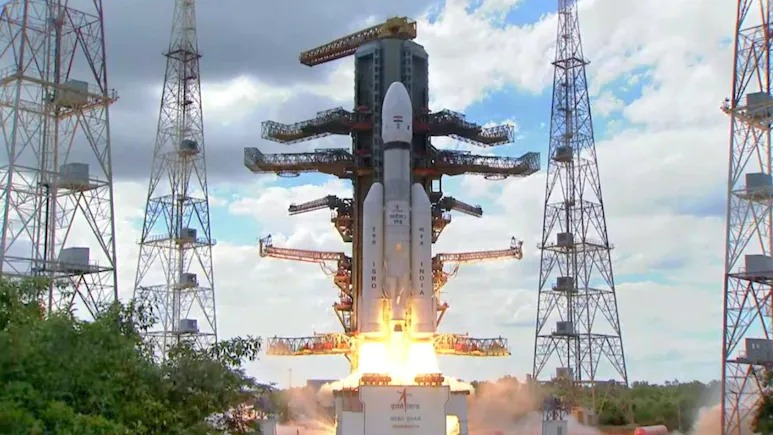
The primary objective of Chandrayaan-4 is to collect samples from the Moon’s surface and bring them back to Earth. This complex mission will involve at least two separate launches of the heavylift LVM-3 rocket, each carrying different components that will be assembled in orbit. The five modules – Ascender Module, Descender Module, Re-entry Module, Transfer Module, and Propulsion Module – will work in tandem to achieve this feat.
Scheduled to launch in 2027, Chandrayaan-4 marks a major milestone in India’s journey to become a global space powerhouse. The mission has received approval from the Union Cabinet, chaired by Prime Minister Narendra Modi, with a budget of ₹2,104.06 crore (US$240 million).
Chandrayaan-4 will demonstrate several cutting-edge technologies, including surface sampling, drilling mechanisms, sample storage, and docking capabilities. The samples will be collected near the landing site of Chandrayaan-3, between the Manzinus P and Boguslawsky M lunar craters near the south pole region. A robotic arm and drilling mechanism will collect and store up to 3 kg of lunar regolith and subsurface samples.
The samples will then be transferred to the Re-entry Module, which is designed to survive atmospheric re-entry and land safely on Earth. This mission aligns with India’s other landmark missions, such as the Gaganyaan space mission and the Samudrayaan deep ocean exploration, further solidifying India’s position in the global space arena.
India is also expanding its space infrastructure to support these missions. A new launch pad is being constructed, and a new launch site in Tamil Nadu’s Tuticorin district is being developed to launch small satellites. These developments are part of a broader strategy to enhance India’s space capabilities.
The Indian space economy, currently valued at USD 8 billion, is projected to grow to USD 44 billion in the next decade, driven by reforms and increased private sector participation. This growth is expected to fuel greater innovation, investment, and international collaborations, positioning India for even greater achievements in the years to come.
Sorry, there was a YouTube error.