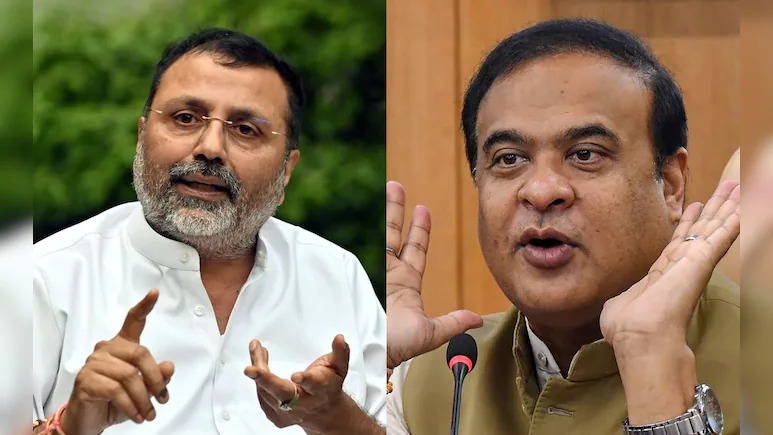
New Delhi: As controversy brews over recent comments by BJP MPs targeting the Supreme Court, Assam Chief Minister Himanta Biswa Sarma has come out strongly in defense of the judiciary while accusing the Congress of a history of undermining judicial credibility. In a detailed post on X (formerly Twitter), Sarma countered the Opposition’s criticism by citing past instances where Congress leaders publicly attacked members of the judiciary.
His statement came amid widespread backlash against BJP MPs Nishikant Dubey and Dinesh Sharma for their remarks on the Supreme Court’s recent verdicts, especially in the context of the Tamil Nadu Bills case. BJP President JP Nadda quickly distanced the party from the MPs’ statements, reaffirming the BJP’s respect for judicial independence.
Sarma Lists Congress’s Past Attacks on Judiciary
CM Sarma emphasized that the BJP has always upheld the dignity of the judiciary and highlighted Nadda’s clarification as a reaffirmation of this stance. He then pivoted to list several incidents involving Congress leaders and judicial criticism:
Impeachment Motion Against Justice Dipak Misra: Sarma pointed out the unprecedented move by Congress and other Opposition parties to initiate an impeachment motion against former Chief Justice Dipak Misra, alleging misconduct without substantive evidence.
Criticism of Justice Ranjan Gogoi: Sarma noted that Justice Gogoi, post-retirement, faced sharp criticism following landmark rulings, including the Ayodhya verdict.
Targeting of Justice Arun Mishra: The former judge and ex-NHRC chief was reportedly accused of being close to the executive, despite acting within constitutional bounds.
Scrutiny of Justice DY Chandrachud: Now the Chief Justice of India, Chandrachud was also criticized over key verdicts, which Sarma suggested stemmed from political bias.
Comments on Justice S Abdul Nazeer’s Appointment: After his retirement, Nazeer was appointed Governor of Andhra Pradesh, a move Congress said compromised judicial independence.
“This pattern suggests a tendency within the Congress Party to challenge the judiciary’s credibility when decisions are unfavorable to their political narrative,” Sarma wrote, adding that such selective outrage erodes public trust in democratic institutions.
Nishikant Dubey Responds with Poetry
MP Nishikant Dubey, whose original remarks prompted criticism and a BJP clarification, responded to Sarma’s post with a sher (couplet) by Urdu poet Fani Badayuni:
“Zindagi jabr hai jabr ke aasaar nahi,
Hai is qaid to zanjeer bhi darkar nahi.”
(Translation: Life is a compulsion, not marked by force; such imprisonment needs no chains.)
Observers suggest the verse may reflect Dubey’s sense of political restraint in light of party disapproval of his earlier statements.
Backdrop: Supreme Court Verdict Sparks Political Firestorm
The row was sparked by the Supreme Court’s recent ruling in the Tamil Nadu Bills case, where the court set a deadline for the President and Governors to act on Bills re-passed by state legislatures. Critics, including Dubey, accused the judiciary of overreach.
Dubey questioned how the Supreme Court could direct the President or Governors—constitutional authorities. “If everything is to be decided by the court, then what’s the role of Parliament?” he asked.
BJP MP Dinesh Sharma also weighed in, stating, “The President is supreme and cannot be challenged.”
In response, BJP President JP Nadda issued a firm statement distancing the party from such views, asserting, “These are personal remarks. The BJP does not support or endorse them.”
Opposition Slams BJP MPs, Defends Judiciary
The Opposition reacted sharply. AIMIM chief Asaduddin Owaisi reminded Parliament of Article 142, which grants special powers to the Supreme Court. “Ambedkar gave us this tool. If you threaten the courts, you threaten the very Constitution,” he said.
Congress leader Jairam Ramesh also condemned the remarks, accusing BJP leaders of trying to weaken the judiciary due to recent verdicts, such as the electoral bonds case, that went against the government.
Vice-President Joins the Debate
Vice-President Jagdeep Dhankhar, too, expressed concern over the court’s authority. He warned against judicial directives aimed at the President, describing Article 142 as a “nuclear missile” being used excessively by the judiciary.
Sorry, there was a YouTube error.