Bhopal: In a staggering revelation that exposes deep-rooted corruption in India’s medical education sector, the Central Bureau of Investigation (CBI) has uncovered a multi-crore scam involving top government officials, educationists, middlemen, and even a self-styled godman. The investigation, which began with a single bribery case in Raipur, has now exploded into what the agency is calling one of the largest medical college scams in the country’s history, spanning several states and implicating high-profile names.
Among those named in the CBI’s FIR are DP Singh, former Chairman of the University Grants Commission (UGC) and current Chancellor of Tata Institute of Social Sciences (TISS); Rawatpura Sarkar, also known as Ravishankar Maharaj; Suresh Singh Bhadoria, the owner of Indore’s Index Medical College; and retired IFS officer Sanjay Shukla, who also served as chairman of the Real Estate Regulatory Authority (RERA) and is a trustee of the Rawatpura educational group. In total, 35 individuals have been named in the FIR, though only one—college director Atul Tiwari—has been arrested so far.
The scam reportedly involves fake inspections, dummy faculty, forged experience certificates, leaked confidential files, and a complex web of hawala and banking transactions used to bribe officials in exchange for regulatory approvals. The investigation began with a ₹55 lakh bribe-for-clearance case at Sri Rawatpura Sarkar Institute of Medical Sciences and Research (SRIMSR) in Raipur, where six individuals, including three doctors, were caught red-handed. The CBI recovered ₹38.38 lakh from one aide and ₹16.62 lakh from the residence of another official involved in the inspection.
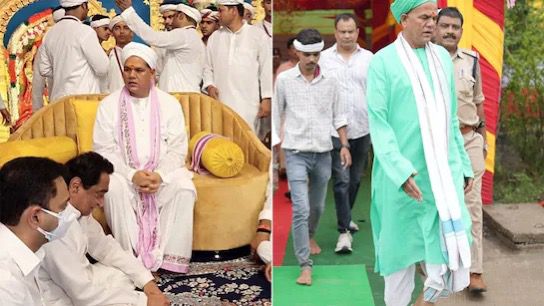
What began in Raipur quickly unraveled into a national network of corruption. At the center of attention is Rawatpura Sarkar, a self-styled spiritual leader with close ties to several politicians and bureaucrats. Often seen in photographs with top IAS and IPS officers, his inclusion in the FIR has reignited scrutiny over his trust’s alleged involvement in land encroachments, unauthorised educational institutions, forced religious activities, and mental harassment allegations—all of which were previously probed by human rights bodies but rarely led to legal action.
The CBI believes that over 40 private medical colleges across the country may have secured approvals through bribes and falsified data. A parallel operation was uncovered at Index Medical College in Indore, where ghost faculty, manipulated biometric attendance, and fake credentials were reportedly used to mislead National Medical Commission (NMC) assessors. The nexus between Bhadoria and Rawatpura Sarkar—both originally from Lahar in Madhya Pradesh’s Bhind district—allegedly charged ₹3 to ₹5 crore per institution for guaranteed NMC recognition.
As the probe widened, investigators found a sophisticated information leak system wherein confidential files from the Ministry of Health were photographed and shared via WhatsApp with college agents. Key figures in this leak included Jitu Lal Meena, a former member of the Medical Assessment and Rating Board (MARB), who acted as a broker and is accused of using part of the illicit funds to construct a ₹75 lakh Hanuman temple in Rajasthan. Others involved in this information racket include Virendra Kumar from Gurgaon, Manisha Joshi from Dwarka, and Mayur Raval, Registrar of Geetanjali University, Udaipur.
The southern arm of the scam was coordinated by agents in Andhra Pradesh and Telangana. B Hari Prasad from Kadiri, Ankam Rambabu in Hyderabad, and Krishna Kishore in Visakhapatnam allegedly arranged dummy faculty and fake patients to deceive inspectors. In one instance, Krishna Kishore collected ₹50 lakh from the director of Gayatri Medical College, while Father Colombo Institute of Medical Sciences in Warangal reportedly paid over ₹4 crore to secure approval, routing bribes through official banking channels to legitimize the transactions.
The CBI’s investigation has revealed a deeply embedded and well-organized racket that compromised the integrity of India’s medical education system. With more arrests expected and the scale of the scam still unfolding, the probe has sent shockwaves through educational and regulatory circles nationwide.