SURAJ NANDRERKAR
DABOLIM: Even as authorities claim the diarrhoea outbreak in Dabolim is “under control,” residents of the affected Prabhu Violetta complex say the crisis is far from over, accusing officials of inaction and indifference even 12 days after the first cases emerged.
The official line rests on a decline in new infections, with only two cases reported in the past two days. But for residents, that number reflects a coping mechanism, not a solution.
“We have stopped using tap water completely. That is the only reason cases have come down,” said Rohan Naik, a resident. “Every day, you see delivery boys bringing in cans of packaged drinking water. We are spending our own money to stay safe.”
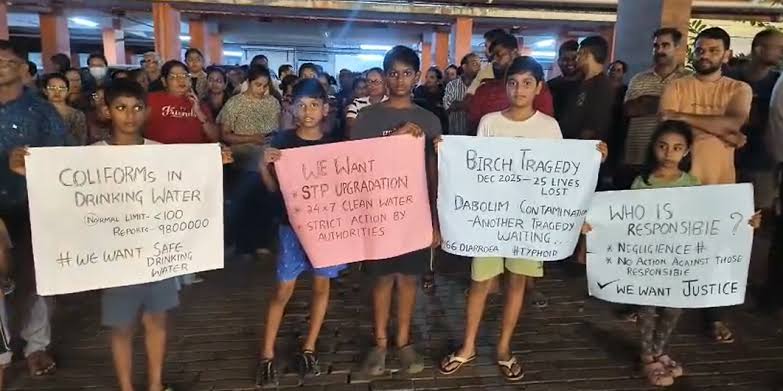
The outbreak, which has affected over a hundred residents, has already been linked to contaminated water. Tests have confirmed high levels of coliform bacteria, rendering the supply unfit for human consumption. Despite this, residents say there is still no clarity on when safe water will be restored.
“What does ‘under control’ even mean when the water is still unsafe?” asked Anita D’Souza. “We are living in uncertainty. We cannot use the water, and no one is telling us when this will be fixed.”
Anger has intensified over what residents describe as a complete absence of political and administrative response on the ground.
“For the past 12 days, people here have been falling sick, but not a single government official has visited the site,” said Sandeep Kamat. “We feel abandoned.”
Residents also pointed out that neither opposition leaders nor members of the ruling party, including the minister representing the Dabolim constituency, have stepped in to address their concerns.
“The only person who has been helping us from day one is Chicalim Sarpanch Kamla Prasad Yadav,” a resident said. “Apart from that, there has been silence.”
The perceived lack of urgency has left the community frustrated, particularly as political attention appears to be focused elsewhere.
“It is disheartening to see leaders busy with other issues like the Corchorem scandal or the Ponda elections while we are dealing with a health crisis here,” said another resident. “Are we not a priority?”
Residents are now openly questioning whether authorities are waiting for the situation to escalate further before acting.
“Are they waiting for a tragedy?” Kamat asked. “How many more people need to fall sick before something concrete is done?”
Officials, however, maintain that the situation is being monitored. A senior health department official said surveillance has been intensified and that precautionary measures have been advised.
“The situation is stable at present. We are keeping a close watch and conducting regular testing of water samples,” the official said.
An अधिकारी from the local administration acknowledged that the water remains non-potable and said efforts are underway to identify the exact source of contamination. “We are examining all possible causes, including pipelines and storage systems. Necessary action will be taken once the source is confirmed,” the official said.
But for residents, these assurances offer little comfort.
“There is no visible action on the ground,” said Naik. “Testing alone is not enough. We need the problem to be fixed.”
Public health experts warn that a drop in new cases in such outbreaks often reflects behavioural changes rather than resolution.
“If people avoid the contaminated source, naturally cases will decline,” said a doctor familiar with the situation. “But the risk remains until the contamination is eliminated.”
Inside Prabhu Violetta, daily life continues under strain. Packaged water cans line corridors, and families remain cautious about even basic use of tap water.
“We just want safe water and some accountability,” said D’Souza. “Right now, we have neither.”