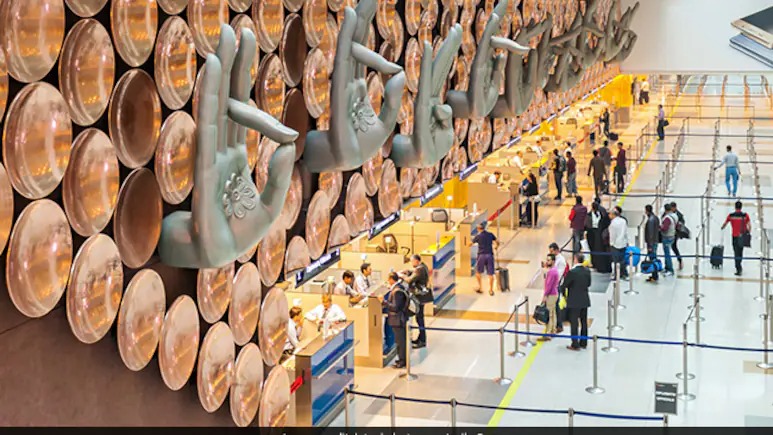
New Delhi: Delhi’s Indira Gandhi International Airport (IGIA) has joined the elite league of the world’s busiest airports by surpassing the 100-million annual passenger capacity mark. With a handling capacity of 109 million passengers, IGIA is now among only six airports globally—and just the second in Asia after Tokyo Haneda—to achieve this milestone.
The achievement followed the full operationalisation of Terminal 1 in May 2023, with Delhi International Airport Limited (DIAL) confirming that the upgraded capacity was sustained through 2024. Plans are also underway to rebuild and modernise Terminal 2 to further enhance capacity.
India’s civil aviation sector has witnessed unprecedented growth over the past decade, supported by flagship initiatives like PM GatiShakti, the National Logistics Policy, Bharatmala, Sagarmala, and UDAN. Operational airports in the country have more than doubled from 74 in 2014 to 162 today, including heliports and water aerodromes.
Official data tabled in Parliament shows Indian airports handled 412 million passengers in 2024–25—77 million international and 335 million domestic—a 9% rise compared to the previous year.
A major contributor to this growth has been the Regional Connectivity Scheme (RCS-UDAN), launched in 2016 to make air travel affordable and accessible. Since inception, 637 RCS routes—including 15 heliports and two water aerodromes—have been launched, connecting 92 underserved and unserved airports, with over 1.51 crore passengers flown.
At the Northern Region Ministers’ Conference last month, Civil Aviation Minister Ram Mohan Naidu highlighted that India has added 88 new airports in the last 10 years—nearly one every 40 days—along with 60 new flights per hour. He emphasized that under Prime Minister Narendra Modi’s leadership, flying in India has become “more available, accessible and affordable,” while reaffirming the government’s focus on inclusive aviation growth through state-specific strategies.