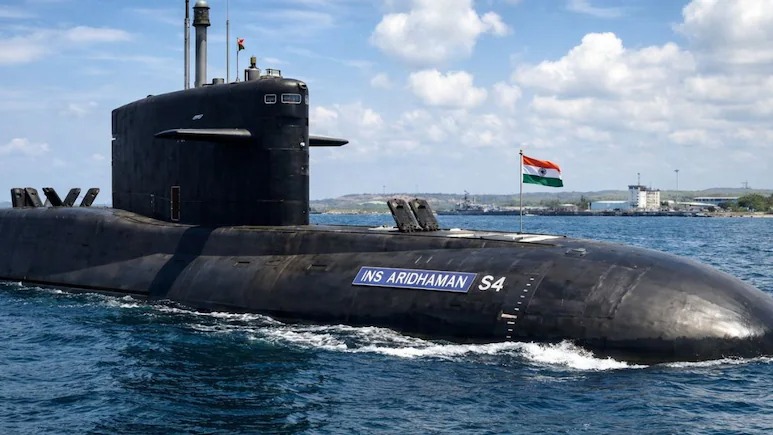
New Delhi: India has inducted its third indigenous nuclear powered submarine, INS Aridhaman, into the naval fleet, significantly strengthening the country’s underwater strategic capabilities. The vessel, whose name translates to “destroyer of enemies,” represents a major technological achievement due to the complexity involved in designing and building nuclear powered submarines.
Part of the Arihant-class submarine, the 7,000 tonne submarine has been built with about ninety percent indigenous technology. Powered by a nuclear reactor, it can operate underwater for long durations without the need to surface for refuelling, giving it a major operational advantage. The submarine is capable of reaching underwater speeds of around 45 kilometres per hour and is designed to conduct strategic nuclear missions.
Compared to its predecessors INS Arihant and INS Arighat, Aridhaman is larger and more powerful. Weighing roughly 1,000 tonnes more, it carries double the missile strike capacity and offers a longer operational range. While the earlier submarines were equipped with four vertical launch tubes, Aridhaman has eight, allowing it to deploy a significantly higher number of ballistic missiles.
The submarine can carry up to twenty four K-15 Sagarika ballistic missiles with a strike range between 750 and 1,500 kilometres. It is also capable of deploying eight long range K-4 missile systems with a reach of about 3,500 kilometres. Future upgrades are expected to include the K-5 missile, which will have an estimated range of around 6,000 kilometres.
With this addition, India further consolidates its position among a small group of nations that operate nuclear powered submarines, alongside the United States, Russia, the United Kingdom, France and China.
During the same event in Visakhapatnam, Defence Minister Rajnath Singh also oversaw the induction of INS Taragiri, the fourth vessel under the Project 17A programme.
Built by Mazagon Dock Shipbuilders Limited, the 6,670 tonne stealth frigate showcases India’s growing shipbuilding capabilities. With more than seventy five percent indigenous content, advanced weapon systems and reduced radar visibility, the warship is designed for high speed maritime operations, anti submarine warfare and humanitarian missions during emergencies.