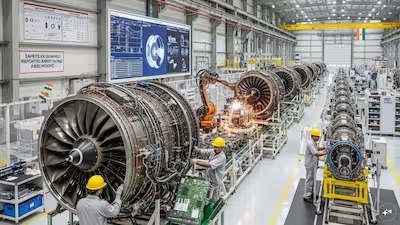
New Delhi: India is taking a significant step toward strengthening its defence technology capabilities with plans to establish a National Aero Engine Test Complex, a specialised facility designed to support the development and validation of indigenous jet engines.
The initiative is being led by the Defence Research and Development Organisation through its laboratory, the Gas Turbine Research Establishment. The proposed complex will function as a comprehensive testing centre where both complete jet engines and individual components such as fans, compressors, combustors, turbines and afterburners can be evaluated under simulated real world conditions.
The facility will include advanced systems capable of recreating high altitude environments along with controlled air heating and cooling mechanisms. These systems will allow engineers to test engines on the ground under conditions similar to those experienced during flight at altitudes of around 40,000 feet, enabling accurate performance assessments.
India has long aimed to develop fully indigenous jet engines but has faced several technical hurdles along the way. The Kaveri Engine Programme, once seen as a major step in that direction, encountered difficulties including challenges in achieving the required thrust levels and ensuring long term reliability. Limited access to advanced testing infrastructure within the country has also been considered a major constraint.
Jet engine development remains one of the most complex technological fields in aerospace. Only a handful of countries such as the United States, United Kingdom, France, Russia and China currently possess the capability to design and produce advanced engines independently.
At present, several Indian fighter aircraft including the HAL Tejas rely on engines supplied by global manufacturers such as General Electric. While these partnerships have supported operational readiness, they also create long term dependence on foreign suppliers and technology.
The proposed testing complex is expected to accelerate indigenous engine development by enabling more frequent and advanced testing cycles. It could also improve reliability, reduce development timelines and support future fighter aircraft programmes with domestically developed propulsion systems.
Beyond defence applications, the project is likely to strengthen India’s aerospace ecosystem by encouraging collaboration with international firms, expanding technological expertise and generating high skill employment opportunities within the country.