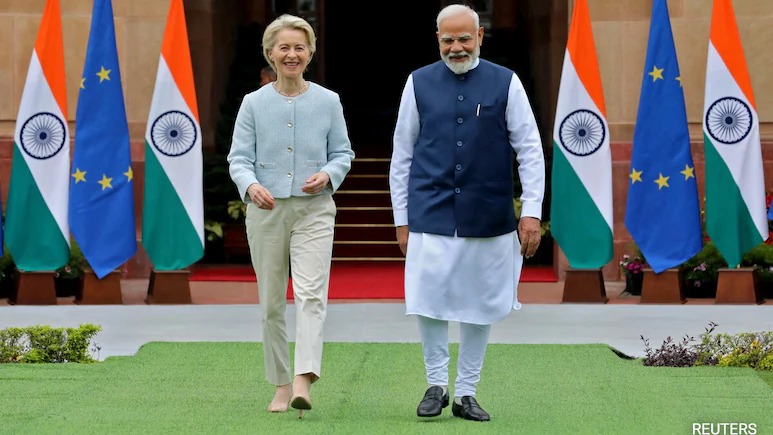
New Delhi: European Commission President Ursula von der Leyen has called for deeper trade and economic engagement with India as part of the European Union’s efforts to reduce its dependency on the United States. Speaking at a conference of German business leaders on Thursday, von der Leyen said that the EU is seeking to finalise a free trade agreement (FTA) with India by the end of this year.
“We want to make a deal with India this year,” von der Leyen said, revealing that Prime Minister Narendra Modi had personally assured her of India’s commitment to the negotiations during a phone call on Wednesday. She added that the EU is also in talks with South Africa, Malaysia, the UAE, and other countries as part of its diversification strategy, with higher US tariffs adding urgency to the effort.
Her remarks came a day after the EU unveiled its New Strategic EU-India Agenda, a comprehensive framework designed to significantly boost cooperation in defence, trade, energy, connectivity, and technology. The agenda aims to “deepen, broaden, and better coordinate” bilateral ties, enhance prosperity and security, and jointly address major global challenges.
“Now is the time to focus on reliable partners and double down on partnerships rooted in shared interests and guided by common values,” von der Leyen said. “With our new EU-India strategy, we are taking our relationship to the next level.”
The new agenda sets out five key areas of collaboration — security and defence, connectivity and global engagement, prosperity, sustainability, and technology and innovation. It also identifies maritime security, cyber defence, counterterrorism, and classified information-sharing as priority areas under the defence pillar.
Europe is currently India’s largest trading partner, and the EU has reaffirmed its commitment to advancing trade, investment, and talent mobility, as well as strengthening industrial cooperation in the defence sector.
The strategic agenda will now go through ratification by all 27 EU member states before its formal adoption at the next India-EU summit, expected in the first quarter of 2026. It also highlights collaboration on major global issues, including Indo-Pacific security, hybrid threats, space cooperation, and responses to Russia’s war in Ukraine.
Additionally, the agenda underscores regional connectivity efforts, including support for the India-Middle East-Europe Economic Corridor (IMEC) and advancing EU’s Global Gateway initiative, signalling a long-term commitment to joint development projects with India and other partners.