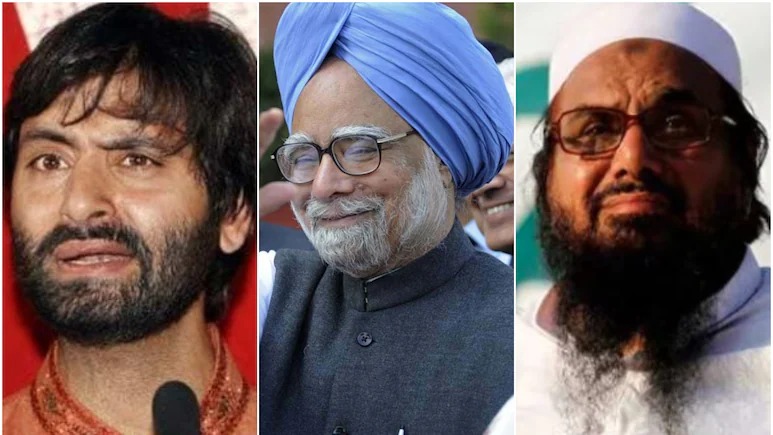
New Delhi: Jailed Jammu & Kashmir Liberation Front (JKLF) chief Yasin Malik has made sensational claims in a sworn affidavit submitted to the Delhi High Court, alleging that his 2006 meeting with Lashkar-e-Taiba (LeT) founder and 26/11 Mumbai attack mastermind Hafiz Saeed was organised at the request of Indian intelligence officials — and personally appreciated by then Prime Minister Manmohan Singh.
Malik, who is serving a life sentence in a terror-funding case, said the meeting was part of a backchannel peace process with Pakistan following the 2005 Kashmir earthquake. He claimed that senior officials of the Intelligence Bureau (IB), including then Special Director V. K. Joshi, instructed him to engage with both Pakistan’s political leadership and top terror figures like Saeed to support New Delhi’s dialogue initiative.
According to the affidavit, Saeed convened a gathering of jihadist groups in Pakistan where Malik delivered a speech urging militants to choose peace over violence. Citing Islamic teachings, Malik said he told the gathering that “if somebody offers you peace, purchase peace with him.”
Malik insists the meeting, which has since been used as evidence of his links to terror groups, was a “government-sanctioned” initiative later misrepresented for political purposes.
The most explosive part of Malik’s statement is his claim that after returning to Delhi, he was debriefed by IB officials and then asked to meet Prime Minister Singh directly.
“I met the Prime Minister Manmohan Singh the same evening where N. K. Narayan, the National Security Advisor, was also present. I briefed him on my meetings and appraised him of the possibilities, where he conveyed his gratitude to me for my efforts, time, patience, and dedication,” Malik said in the affidavit.
He further alleged that Singh told him, “I consider you the father of the non-violent movement in Kashmir.”
Malik said his interactions with Indian leaders were not limited to Singh. He claimed he had been “actively engaged” by six successive governments, from V. P. Singh to Atal Bihari Vajpayee, and had been encouraged to represent the Kashmiri cause on domestic and international platforms.
Malik’s claims, if proven true, could trigger a major political storm by exposing the covert tactics used by Indian governments to engage separatist leaders and even terror masterminds as part of peace efforts. The affidavit directly places a former Indian Prime Minister at the centre of a highly controversial outreach involving one of the world’s most wanted terrorists.
Malik, who remains a highly polarising figure, is also accused of killing four Indian Air Force personnel in 1990 and orchestrating the kidnapping of Rubiya Sayeed, daughter of then Union Home Minister Mufti Mohammad Sayeed. Kashmiri Pandits continue to hold him responsible for their mass exodus from the Valley in the 1990s.
For now, Malik’s affidavit stands as an explosive intersection of diplomacy, intelligence operations, and terrorism reviving questions over India’s past peace process with Pakistan and the price paid for dialogue.