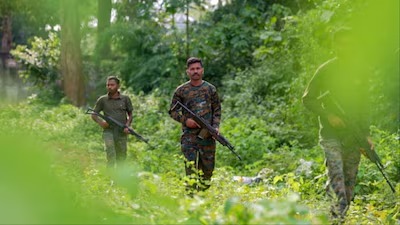
New Delhi: India’s decades long struggle against Left Wing Extremism has entered what authorities describe as its concluding phase, with extremist activity now confined to a small number of districts. Security reviews indicate that the insurgency, once spread across a vast stretch of the country, has significantly weakened due to sustained operations, development initiatives and rehabilitation programmes.
Recent assessments show that the remaining Maoist presence is concentrated largely in parts of Chhattisgarh and Jharkhand. In Chhattisgarh, districts such as Bijapur, Sukma, Narayanpur, Dantewada and Kanker continue to report some level of extremist activity. Among them, Bijapur, Sukma and Narayanpur are considered the most affected areas due to the presence of Maoist leadership networks and armed groups operating in forested border regions.
Security forces have intensified operations in these locations, particularly in the Bastar division of Chhattisgarh. Several Maoist cadres have surrendered in recent weeks as authorities continue outreach efforts encouraging militants to return to mainstream society. During a recent development in Sukma district, a Maoist carrying a reward of ₹5 lakh was killed in an encounter during a search operation conducted by the District Reserve Guard.
Officials report that nearly 96 per cent of the Bastar region is now free from Maoist influence. Plans are underway to transform former security camps in the area into public facilities such as schools and hospitals as part of a broader development push.
Meanwhile, several states that were once part of the so called Red Corridor have reported the near elimination of Maoist presence. Odisha has seen a sharp decline in extremist activity, with only a handful of cadres reportedly remaining in Kandhamal district. Districts that once witnessed insurgent activity including Malkangiri, Koraput, Bolangir, Boudh, Nuapada, Nabarangpur, Rayagada and Kalahandi have now been cleared of Maoist influence.
Similar progress has been reported in Telangana, where more than 700 Maoists have surrendered in the past two years under rehabilitation policies. Maharashtra has also made significant gains, with Gadchiroli district, once a major Maoist stronghold, nearing complete elimination of insurgent activity. Madhya Pradesh has already been declared free from Maoist influence.
Security officials say declining recruitment and increasing surrenders have weakened the movement considerably. Experts also point to improved infrastructure, welfare schemes and stronger governance in tribal regions as factors reducing the appeal of extremist ideology.
Once described as India’s biggest internal security challenge, the Maoist insurgency has steadily receded over the past decade. While small pockets remain active, authorities expect continued operations and rehabilitation measures to eliminate the remaining networks, even as development initiatives expand in previously affected regions.