Team Goemkarponn
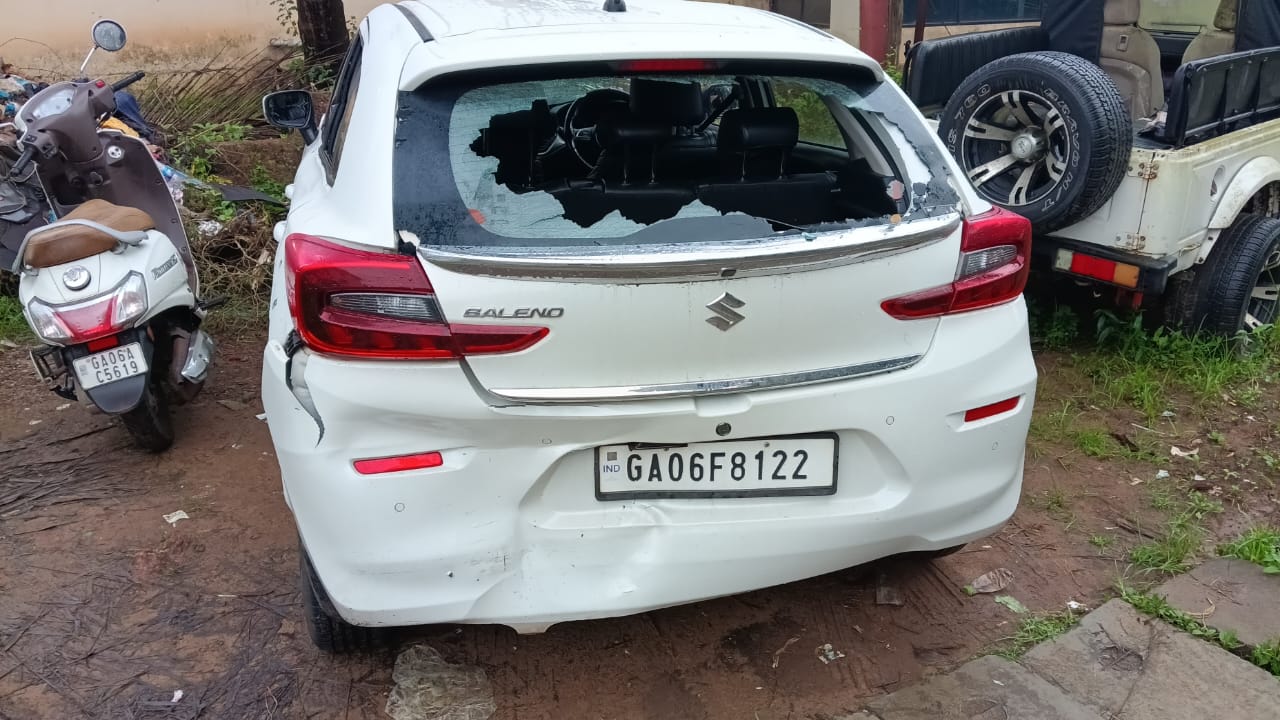
Margao: South Goa woke to scenes of violence and fear on Tuesday morning after a brutal gang attack in Mungul, along the Margao–Colva Road, left two young men injured and a car peppered with bullet holes.
The assault, carried out with swords, sticks, and gunfire, has sparked a fierce political row and renewed public concern over Goa’s crumbling law and order.
The incident occurred near Shagun Hotel when a Baleno intercepted the victims’ vehicle around dawn.
According to police, 4-5 assailants set upon the occupants, identified as Rafiq Tashan (24) and Yuvkesh Singh (20), beating them with swords and sticks before firing two bullets at their car.
The attackers then fled, leaving the victims bloodied and the vehicle severely damaged.
Both victims were rushed to Goa Medical College. Singh is undergoing surgery for his injuries, while Tashan remains admitted in the ward.
South Goa Superintendent of Police Tikam Singh confirmed that an FIR has been registered and multiple teams have been deployed to trace the culprits.
“It appears to be a case of gang rivalry. The investigation is underway,” he said.
The violence has triggered an outpouring of anger. Revolutionary Goans Party (RGP) chief Manoj Parab blamed “vote-bank politics” for eroding Goa’s social fabric and enabling criminal elements to operate without fear.
“Our real Goan identity is finished, and our culture has suffered genocide. The peaceful Goan way of life is over. This gang war is proof,” Parab declared, calling for strict enforcement of the Persons of Goan Origin (POGO) law to curb crimes by what he described as “migrant goons.”
Locals say the attack is the latest in a disturbing pattern of street violence in the Margao–Colva belt, often linked to rival gangs.
Residents fear that without decisive action, such brazen crimes will become the norm.
“When bullets start flying on our streets, it’s a sign the fear of the law is gone,” said a resident, unwilling to be named.
With no arrests yet and tensions running high, the Mungul attack has become both a law enforcement challenge and a political flashpoint—one that will test the state’s ability to restore public trust in safety and governance.