Team Goemkarponn
PANAJI: Goa Chief Minister Pramod Sawant has unveiled plans for major financial allocations in the upcoming State Budget to support group farming and the overall development of the agriculture sector, reinforcing the state’s vision of a self-reliant Goa.
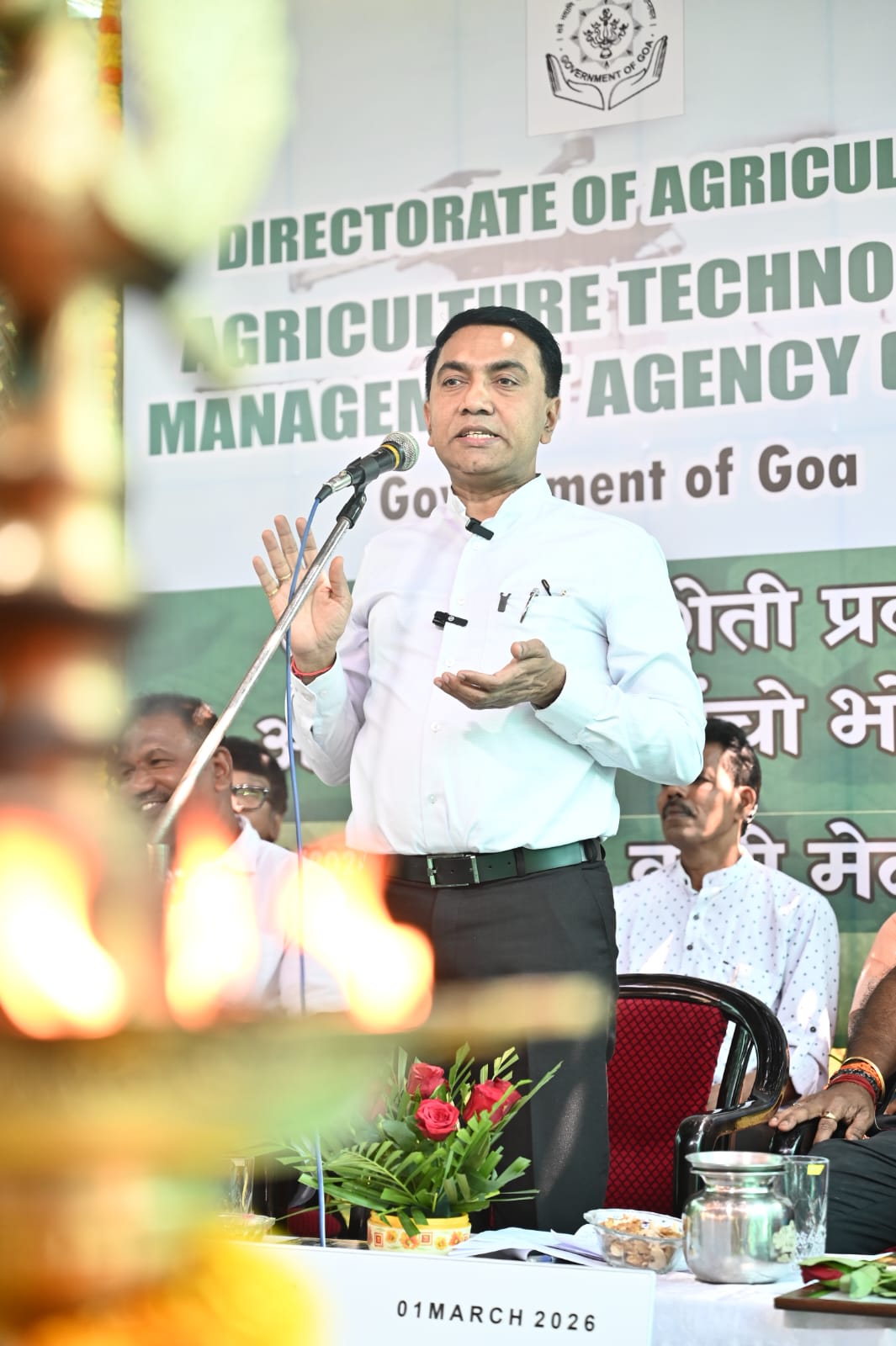
Speaking at the launch of the Group Farming Scheme in Surla, Sawant emphasized the goal of achieving 100 percent agricultural self-sufficiency within the next ten years. He stressed that agriculture will play a pivotal role in Goa’s economy, reducing over-reliance on tourism and mining.
Highlighting the importance of farmers in the state’s growth strategy, the Chief Minister called for a move toward collective farming and modern agricultural methods. He underscored the government’s objective to empower farmers as entrepreneurs, ensuring better incomes and long-term financial stability.
Noting that nearly 18,000 hectares of khazan land remain uncultivated, Sawant urged especially young farmers to bring fallow land back into productive use. He assured landowners that the group farming model would not affect ownership rights and that no land would be forcibly acquired, while cautioning against leasing agricultural land for non-farming purposes.
Sawant also called for sustainable farming practices, including organic cultivation, modern irrigation, mechanization, and adoption of technology to boost productivity. He emphasized that no cultivable land should remain idle and affirmed that the Agriculture and Irrigation Departments will provide full support to farmers. Consumers, he added, should prefer fresh, locally grown produce over imported alternatives.
The integrated farming initiative will promote allied sectors such as dairy, fisheries, poultry, and horticulture, alongside multi-cropping systems. Sawant noted that agriculture should provide stable, sustainable income, complementing rather than competing with tourism and mining.
Officials from the Agriculture Department and the Agricultural Technology Management Agency (ATMA) were instructed to work closely with farmers, offering guidance and encouraging innovation. Progressive farmers were felicitated at the event, while Agriculture Director Sandeep Faldesai detailed ongoing initiatives.
The programme also saw the launch of four community farming projects in Sankhali and Bicholim talukas to revive fallow lands and preserve traditional khazan farming techniques.
Under the Community Farming Assistance Scheme, farmer groups of ten or more are eligible for 90 percent financial support for fencing, irrigation, and mechanization. For 2025–26, subsidies of Rs 80.02 lakh have been approved for ten such groups across Goa.
Additionally, the ATMA Awards 2025–26 were announced to honour agricultural innovation. Two district-level farmers will receive Rs 25,000 each, while five farmers per taluka will be awarded Rs 10,000 each for outstanding contributions to farming and allied sectors.