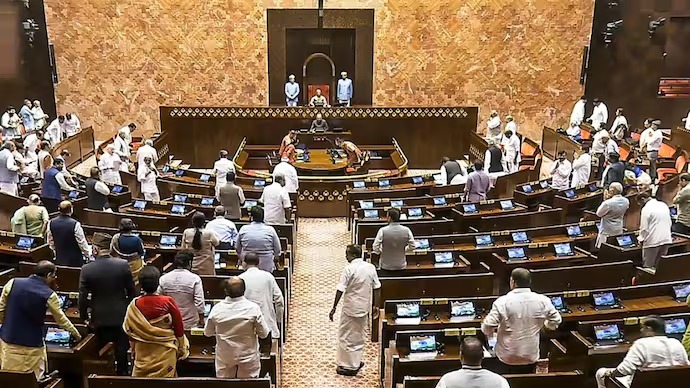
New Delhi: The government introduced the Central Armed Police Forces (General Administration) Bill, 2026 in the Rajya Sabha on Wednesday, seeking to establish a common administrative framework for personnel serving in the country’s Central Armed Police Forces. The bill was tabled despite objections from opposition members and was allowed to be introduced through a voice vote.
The proposed legislation aims to streamline service rules across the five Central Armed Police Forces by replacing the existing system where each force follows its own set of regulations. The government says the new law will bring greater uniformity and clarity in matters related to administration and personnel management.
Introducing the bill in the upper house, Nityanand Rai addressed concerns raised by members about its scope and implications. He clarified that the proposed legislation would not alter the existing governance structure or operational mandates of the forces. According to him, the powers, duties and administrative systems of the forces would remain unchanged under their current frameworks.
The move sparked debate in the House, with several opposition members questioning the intent and constitutional implications of the legislation. Responding to these concerns, Kiren Rijiju defended Parliament’s authority to legislate. He emphasised that the Constitution grants Parliament full competence to enact laws and argued that the legislature should not relinquish its responsibilities based on anticipated judicial interpretations.
The proceedings saw moments of tension as opposition leaders attempted to speak at length about their objections. Harivansh Narayan Singh initially limited the discussion, allowing brief interventions in line with established parliamentary practice.
Several members used their allotted time to express reservations about the bill. Jairam Ramesh sought more time for members to present their arguments, while Derek O’Brien criticised the legislation as anti federal. Other leaders including Ajay Maken, Vivek Tankha and Tiruchi Siva raised concerns about constitutional rights, financial implications and the balance of power between Parliament and the judiciary.
The debate highlighted sharp differences between the government and opposition over the proposed changes, setting the stage for further discussion on the bill in the coming parliamentary sessions.
Sorry, there was a YouTube error.