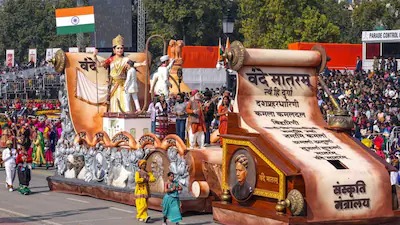
New Delhi: The Union Home Ministry has released new directions governing the use of Vande Mataram, making it mandatory for the national song to be sung before the National Anthem at government functions and in educational institutions. The guidelines require everyone present to stand in attention while the song is performed.
The revised rules bring clarity on how Vande Mataram should be presented and respected across the country. A major change is the inclusion of all six stanzas of the song, a version lasting about three minutes and ten seconds. Earlier, only the first two stanzas were commonly used at official occasions.
According to the notification, whenever both Vande Mataram and Jana Gana Mana are part of a programme, the national song must be played first. Schools have been directed to include it in assemblies and promote awareness about national symbols among students. The song will also be performed at state ceremonies, civilian award functions, flag hoisting events and during formal arrivals and departures of the President and Governors.
The government stated that the decision was taken to establish a uniform protocol similar to the one that already exists for the National Anthem. Officials said the move aims to ensure respectful observance of the song at public functions and to strengthen its role in national life. The guidelines came amid ongoing commemorations marking 150 years of Vande Mataram.
The rules apply immediately to government programmes and school events, but they will not extend to movie theatres where the song may appear as part of a film. Citizens attending official ceremonies are expected to stand respectfully while the song is played, though legal provisions regarding enforcement are still under consideration.
Vande Mataram was composed by Bankim Chandra Chatterjee in the 1870s and later became a powerful symbol of the freedom movement. After independence, it was adopted as the national song in 1950. The decision to restore all six stanzas has revived political debate, with supporters calling it a correction of historical neglect while critics argue that earlier limitations were based on concerns of social harmony.
The Home Ministry expressed hope that the new framework would encourage greater appreciation of the song and reinforce respect for India’s cultural heritage and national identity.
Sorry, there was a YouTube error.