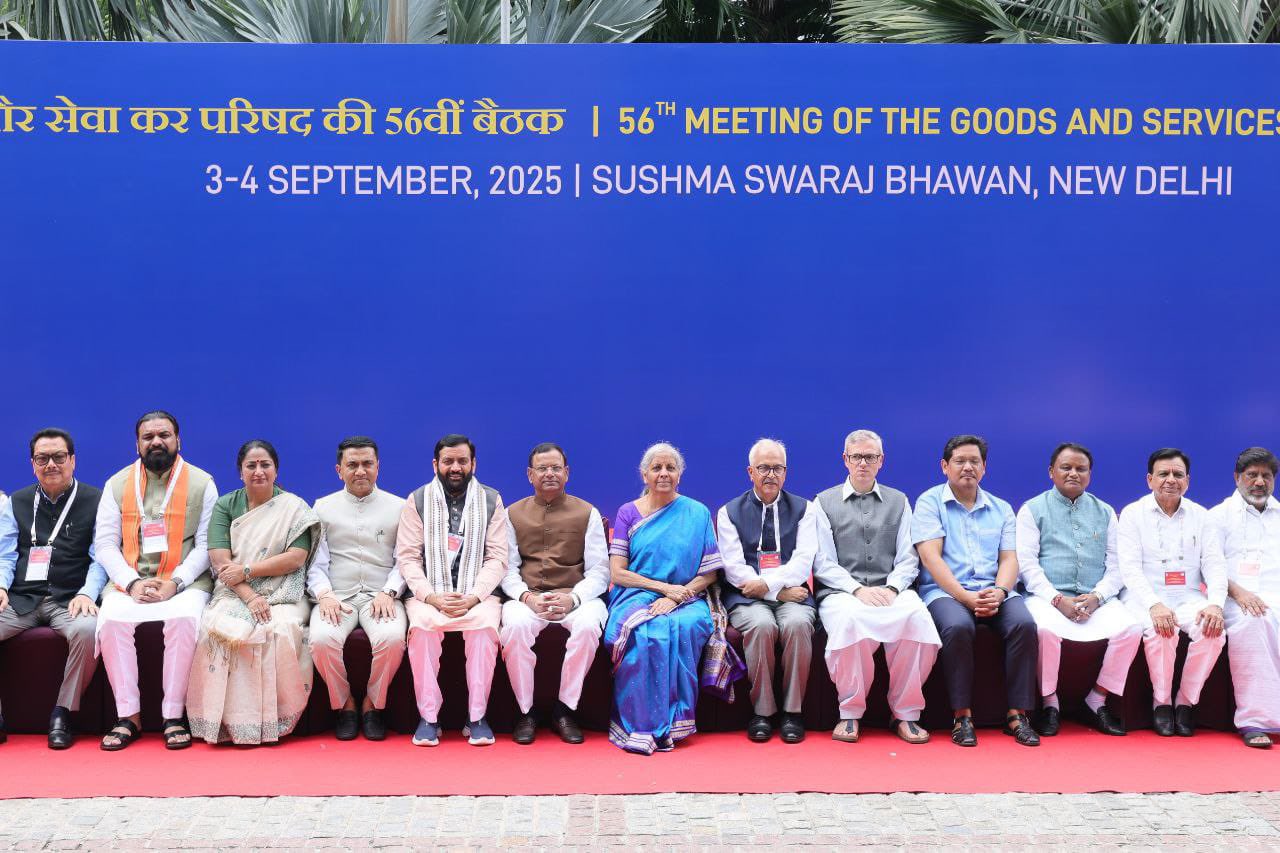
New Delhi: The Goods and Services Tax (GST) Council, chaired by Finance Minister Nirmala Sitharaman, met today to consider one of the biggest tax reforms since GST was introduced. At the center of the agenda is a proposal to simplify the current four-slab system into a two-rate structure, potentially lowering prices of daily essentials and offering relief to the middle class. Prime Minister Narendra Modi has hailed the move as “next-generation” reform. The government expects the rationalisation to spur consumption and offset a projected ₹50,000 crore revenue loss.
Under the proposed system, goods will be classified as merit or standard, with essentials falling under the 5% slab and most other items taxed at 18%. A special 40% “sin tax” will apply to a small list of luxury items, including tobacco and high-end automobiles, covering only five to seven products. Daily-use items currently taxed at 12% are likely to shift to the 5% bracket, while 90% of goods in the 28% category may move down to 18%, offering substantial savings to consumers.
The reforms are expected to boost middle-class spending, support economic growth, and partially counter the impact of 50% US tariffs on nearly $48 billion worth of Indian exports. GDP growth for the first quarter of FY26 has already exceeded expectations at 7.8%, compared to an earlier forecast of 6.5%, highlighting the potential benefits of increased consumption. According to an SBI Research report, the combined impact of GST reforms and recent income tax cuts could increase consumption by ₹5.31 lakh crore, or roughly 1.6% of GDP.
The government has framed the changes around three key pillars – structural reform, rate rationalisation, and ease of living – in line with its goal of making India aatmanirbhar (self-reliant) and advancing towards becoming the world’s third-largest economy. However, several opposition-ruled states, including Tamil Nadu, Punjab, and West Bengal, have raised concerns about potential revenue losses and are demanding compensation. Eight state finance ministers are expected to present proposals to maintain revenue neutrality, including suggestions to levy additional duties on sin and luxury goods, with proceeds shared among states.
If implemented, the two-rate GST system could make essentials more affordable, spur consumption, and give the economy a boost. The challenge will be ensuring that the reform balances rate cuts with revenue needs while keeping states on board in what could be the most significant GST revamp since 2017.