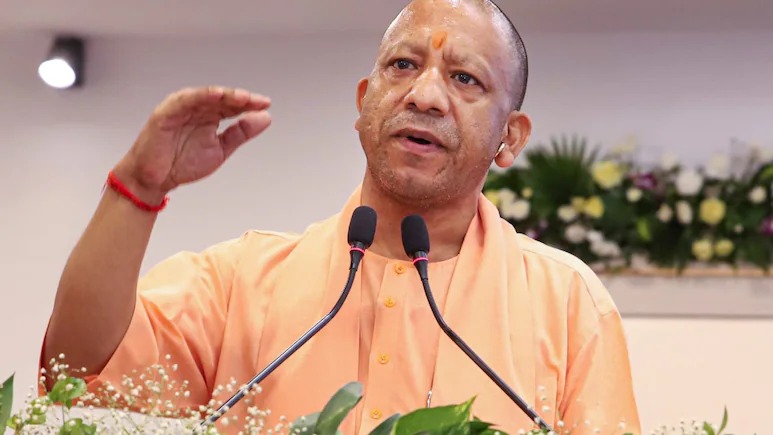
New Delhi: Uttar Pradesh Chief Minister Yogi Adityanath on Tuesday said that centuries of foreign invasions and colonial rule in India not only exploited the country’s resources but also led to a significant decline in the Hindu population.
Speaking at a state-level workshop on ‘Atmanirbhar Bharat–Swadeshi Sankalp’ in Lucknow, the Chief Minister claimed that the Hindu population, which he estimated at around 60 crore in the year 1100, had reduced to about 30 crore by the time India achieved Independence in 1947. “By the year 1100, the Hindu population in India was 60 crore. And when the country gained independence in 1947, it was only 30 crore. Tell me, should our population have increased or decreased in these 800–900 years?” he asked the gathering.
Yogi Adityanath said that despite having abundant resources, India’s progress was hindered by divisive policies imposed by foreign rulers. “What did India not have? It had everything. But some divided people on the basis of caste, region, and language. And even today, they operate with the same foreign mentality, continuing to divide society,” he said.
Linking his remarks to the government’s call for self-reliance and promotion of indigenous production, the Chief Minister said Prime Minister Narendra Modi’s Swadeshi campaign aims to empower Indian workers and youth. “They will point fingers at this campaign in every way. But the Prime Minister’s message is that we should promote whatever is made with the labour of Indian workers and the talent of our youth,” he added.
His comments came a day after the Central government rolled out GST 2.0, a major reform in India’s indirect tax system. On the occasion, Prime Minister Modi addressed the nation through a letter, calling the rollout the beginning of the ‘GST Bachat Utsav’ (GST Savings Festival), which he said will boost savings and benefit every section of society.
Extending greetings on Navratri, PM Modi said the reforms will help drive growth, attract investments, and accelerate progress across all regions. “They will directly benefit farmers, women, youth, the poor, middle-class citizens, traders, and MSMEs,” the Prime Minister’s letter said.