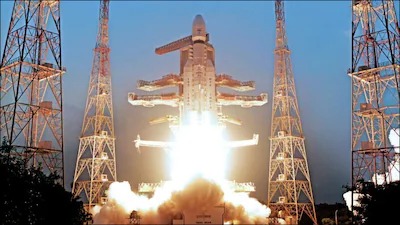
New Delhi: The Indian Space Research Organisation (ISRO) marked a historic achievement on Sunday by successfully launching its heaviest communication satellite on an Indian-made rocket. The CMS-03 satellite, weighing 4,410 kg, was placed into a Geosynchronous Transfer Orbit (GTO) aboard the 43.5-metre-tall LVM3-M5 rocket, popularly known as ‘Bahubali’ for its heavy-lift capabilities. The launch took place at 5:26 pm from the second launch pad at the Satish Dhawan Space Centre in Sriharikota, Andhra Pradesh. Prime Minister Narendra Modi and Vice President CP Radhakrishnan congratulated ISRO for the milestone, praising the country’s growing expertise and innovation in space technology.
CMS-03 is a multi-band communication satellite designed to provide services over a wide oceanic region, including India, and will replace the GSAT-7 series launched in 2013. The LVM3-M5 rocket, formerly known as GSLV Mk 3, is a three-stage launch vehicle featuring two solid motor strap-ons (S200), a liquid propellant core stage (L110), and a cryogenic stage (C25). Dubbed ‘Bahubali’, the rocket can launch satellites up to 4,000 kg to GTO and 8,000 kg to Low Earth Orbit (LEO). This launch also showcased a successful re-ignition of the C-25 cryogenic engine’s thrust chamber after placing the satellite in orbit, demonstrating ISRO’s advanced technical capabilities.
All eight LVM3 launches to date, including the experimental mission, have been successful, maintaining a 100% success rate. ISRO Chairman V. Narayanan revealed that the space agency plans to carry out seven more launches over the next five months, further highlighting India’s growing ambitions in space exploration. The launch was also lauded for its strategic significance, as Lt Gen A K Bhatt (retd), Director General of the Indian Space Association (ISPA), said CMS-03 will strengthen maritime and national security by providing advanced and secure communication channels critical to the Indian Ocean Region and the mainland.
Prime Minister Modi said, “Powered by our space scientists, it is commendable how our space sector has become synonymous with excellence and innovation.” Vice President Radhakrishnan added, “This indigenously developed satellite will strengthen space-based communications, connectivity, and maritime domain awareness across the Indian Ocean Region, marking another proud milestone in Aatmanirbhar Bharat.” Previously, ISRO’s heaviest communication satellite was GSAT-11, weighing 5,854 kg, launched in 2018 from French Guiana using the Ariane-5 rocket. However, Sunday’s launch represents the heaviest satellite placed into orbit using an Indian rocket.
Looking ahead, ISRO’s LVM3 platform is planned as the human-rated launch vehicle (HRLV) for the ambitious Gaganyaan mission, scheduled for 2027, underscoring India’s rising stature in the global space arena.