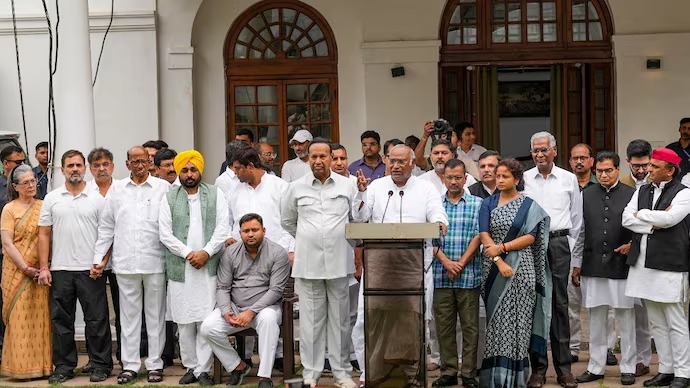
New Delhi: The shock defeat in Bihar has triggered the most serious internal crisis yet for the INDIA alliance. What had long been whispered privately has now spilled out into the open, with regional partners challenging the Congress-led coalition’s planning, leadership and ability to hold the opposition together. Discontent that once surfaced as muted concerns has evolved into pointed criticism, public disagreements and active conversations within several parties about whether to recalibrate their relationship with the bloc or walk away entirely.
JMM’s Breakaway Sets Off Tensions
Signs of strain were visible even before the campaign began. The Jharkhand Mukti Morcha abruptly withdrew from the coalition’s seat-sharing arrangement in Bihar after accusing senior partners of disregarding them during negotiations and failing to keep prior commitments.
Since then, JMM leaders have argued that the Bihar episode reflects what they see as a deeper problem. They believe regional forces are treated as subordinate players rather than equal contributors. The party is now reviewing whether it should continue participating in joint opposition platforms, including in its home state.
Shiv Sena (UBT) Questions Coordination
The Shiv Sena (UBT) has described the Bihar results as a wake-up call. Senior leaders say the defeat exposed the alliance’s weak coordination and the absence of a unified strategy. Party voices have criticised the manner in which several state Congress units took unilateral decisions, including contesting independently in some seats, undercutting the coalition’s agreed approach.
According to the UBT leadership, the bloc cannot function effectively if larger parties do not take allies into confidence when making key electoral decisions.
Samajwadi Party Calls for Structural Overhaul
The Samajwadi Party has been forthright in demanding major course corrections. Party chief Akhilesh Yadav has highlighted procedural lapses in Bihar and warned that similar disruptions must not be allowed to shape future contests.
Across the opposition spectrum, there is now growing support for a more decentralised structure that gives state parties a stronger voice in national planning. The SP is emerging as an influential force in pushing this conversation.
AAP’s Solo Strategy Gains New Context
The Aam Aadmi Party’s choice to contest Bihar on its own, made months before voting, is being viewed differently after the defeat. Party leaders say they foresaw structural weaknesses in the alliance and believed their state-by-state growth could not be subordinated to a loosely coordinated national umbrella.
With dissatisfaction rising among other partners, AAP’s insistence on organisational autonomy is increasingly being cited as a model regional players may consider if their concerns remain unresolved.
Congress Confronts Tough Questions
For the Congress, the Bihar outcome has intensified scrutiny. Senior figures privately admit that the party’s performance, particularly in a Hindi heartland state, weakens its leverage in upcoming seat-sharing talks.
Several allies have communicated that for the bloc to remain credible, the Congress must revamp its organisational style, candidate selection and election management. Others stress the need for a transparent and institutionalised decision-making system, something they argue has been missing.
A Moment of Reckoning for the Alliance
Analysts say the INDIA bloc is facing a defining moment. In the immediate term, the alliance will need swift outreach, confidence-building efforts and clarity on seat distribution to prevent further fragmentation. Over the long term, the bloc must decide whether it is willing to reshape itself into a structure that genuinely reflects the strengths and ambitions of regional parties.
Many allies are now weighing a difficult choice. They can stay in a coalition whose leadership is under growing strain or pursue an independent course to safeguard their political relevance in their home states.
For now, the criticism is unabashed, the calls for reform are getting louder and the Bihar verdict has transformed simmering discontent into the bloc’s most visible identity crisis yet.