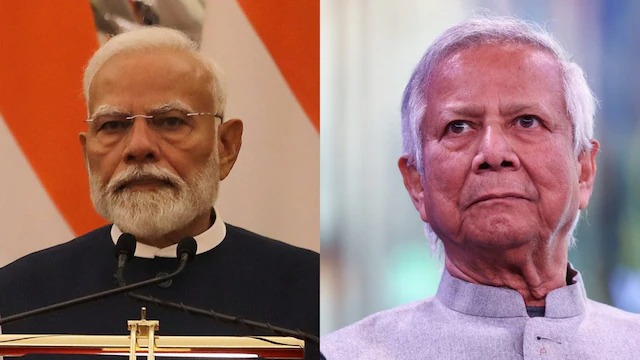
New Delhi: Strains in India-Bangladesh relations have deepened in recent months following a series of controversial decisions and remarks by Bangladesh’s interim government, headed by economist and Nobel laureate Muhammad Yunus. From provocative statements on India’s Siliguri Corridor to a tilt towards China, the evolving dynamics are raising alarms in New Delhi.
India has taken strong exception to Bangladesh’s comments on communal violence in Murshidabad, calling the remarks “unwarranted” and urging Dhaka to first address the growing persecution of minorities within its own borders.
A Changing Political Landscape
The political shift in Bangladesh following the ouster of Prime Minister Sheikh Hasina in August 2024 has significantly altered Dhaka’s foreign policy posture. Under Hasina, Bangladesh maintained a strategic balance between India and China. However, this balance appears to be unraveling.
Yunus’ first official state visit to China from March 26 to 29 and his meeting with President Xi Jinping signaled a notable pivot towards Beijing. Subsequently, Bangladesh’s interim government has begun aligning more closely with China on economic and strategic matters — a development that has unsettled New Delhi.
Further aggravating tensions was Yunus’ controversial comment describing India’s northeast as “landlocked” and asserting that Bangladesh is the ‘sole guardian of the ocean’ for the region. India responded by bolstering its security preparedness at the Siliguri Corridor, deploying S-400 air defence systems and Rafale fighter jets to the Hashimara Airbase.
The Strategic Sensitivity of Siliguri Corridor
Often referred to as the ‘Chicken’s Neck’, the Siliguri Corridor is a narrow, 22-kilometre-wide stretch that serves as India’s only land link to its northeastern states. Bordered by Nepal, Bhutan, and Bangladesh, and lying close to China, it is considered one of India’s most strategically vulnerable areas.
Any instability in this region or aggressive posture from neighbouring countries could risk severing India’s connectivity with its northeastern states — a concern amplified by China’s growing influence in South Asia.
Key Flashpoints in India-Bangladesh Relations
Vandalism at Sheikh Mujibur Rahman’s Residence
On February 5, protesters vandalised the historic home of Bangladesh’s founding father, Sheikh Mujibur Rahman, in Dhaka. The incident occurred during a virtual address by his daughter, Sheikh Hasina, who is currently in exile in India.
India condemned the attack, calling it a blow to the shared history and values of the two nations. Bangladesh’s interim government, however, dismissed India’s concerns, blaming Hasina’s “provocative statements” for inciting unrest.
Controversial Social Media Post by Presidential Aide
In December 2024, Mahfuz Alam, an aide to Muhammad Yunus, shared a Facebook post depicting Indian states — West Bengal, Assam, and Tripura — as part of a “Greater Bangladesh”. India lodged a strong diplomatic protest, leading to the post’s deletion.
Targeted Attacks on Hindu Minorities
Following political instability, reports have emerged of widespread attacks on Hindu homes, temples, and businesses in Bangladesh. Rights group Ain o Salish Kendra documented at least 147 incidents of vandalism and violence in recent months.
Prime Minister Narendra Modi raised the issue during a bilateral meeting at the BIMSTEC Summit in Bangkok, urging Bangladesh to protect all minority communities.
Extradition Request for Sheikh Hasina
The interim government has formally requested India to extradite Sheikh Hasina to face charges over alleged political unrest during her premiership. India has so far declined, citing diplomatic norms and security concerns. The move has sparked rising anti-India sentiment in Bangladesh.
______________
India’s Position
India has made it clear that any attempt to destabilize regional peace or exploit internal issues for geopolitical advantage will be met with firm diplomatic and strategic responses. Officials in New Delhi have reiterated their commitment to protecting Indian interests in the region while advocating for peaceful and respectful bilateral engagement.
As tensions simmer, the geopolitical fault lines in South Asia are becoming more pronounced, with the India-Bangladesh-China triangle emerging as a key theatre for future diplomatic and security manoeuvres.