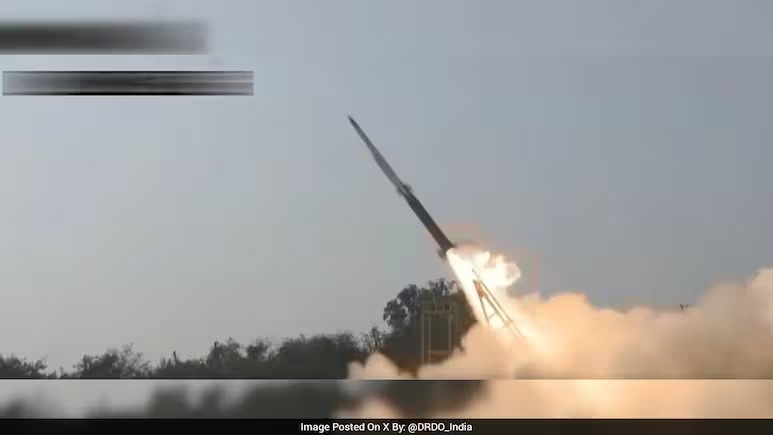
New Delhi: India achieved a major milestone in defence technology with the successful flight test of solid fuel ducted ramjet system, a key platform for developing next generation long range air to air missiles. The demonstration was carried out by the Defence Research and Development Organisation at the Integrated Test Range in Chandipur along the Odisha coast.
The achievement positions India among a small group of countries that possess this complex propulsion technology. Defence officials said the system is expected to provide a significant tactical advantage by enabling missiles with greater range, speed and accuracy.
According to the defence ministry, the trial validated the performance of several critical subsystems including the nozzle less booster, the ramjet motor and the fuel flow controller. The vehicle was first propelled by a ground booster to reach the required Mach speed, after which the ramjet mechanism took over and functioned as planned.
Data from the flight was captured through multiple tracking instruments installed at the test range and along the Bay of Bengal coastline. Scientists confirmed that the parameters recorded during the mission matched the expected design objectives, marking the test as a complete success.
Defence Minister Rajnath Singh congratulated the DRDO and partner industries for the accomplishment, describing it as a significant step toward strengthening the country’s indigenous missile capabilities. Senior officials noted that mastery of this technology would allow India to develop highly advanced air combat systems in the future.
The launch was overseen by experts from various DRDO laboratories, including the Defence Research and Development Laboratory, High Energy Materials Research Laboratory, Research Centre Imarat and the Integrated Test Range. The chairman of DRDO also commended the teams involved for their coordinated effort and technical excellence.
The solid fuel ducted ramjet concept is considered crucial for modern aerial warfare as it supports sustained high speed propulsion without the need for onboard oxidiser. With this demonstration, India has moved closer to fielding home grown long range air to air missiles and reducing dependence on imported systems, reinforcing its broader goal of self reliance in defence technology.
Sorry, there was a YouTube error.