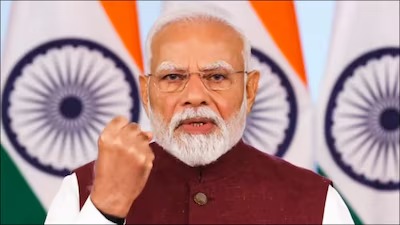
New Delhi: In a strong and direct message to Washington, Prime Minister Narendra Modi declared that India will “never compromise” on the interests of its farmers, amid rising trade tensions with the United States over India’s continued import of Russian oil.
The statement follows the U.S. decision—driven by former President Donald Trump’s renewed calls for punitive trade measures—to impose an additional 25% tariff on certain Indian exports. The move was ostensibly in response to India’s ongoing purchase of discounted Russian crude, a lifeline for its energy security.
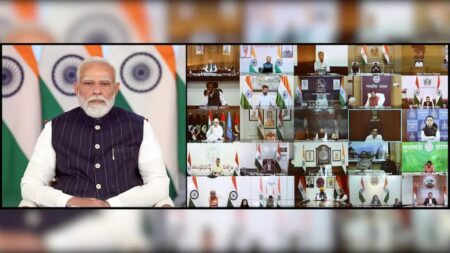
Addressing a gathering in Gujarat on Wednesday, PM Modi underlined his government’s unwavering commitment to protecting the agricultural sector. “India’s farmers are the backbone of our economy. No foreign pressure will force us to act against their interest. Our policies are determined by national priorities, not external ultimatums,” he said.
The Ministry of External Affairs (MEA), in a sharply worded statement, slammed the U.S. decision as “unfair, unjustified, and unreasonable.” The ministry pointed out that India’s oil imports are governed by global market dynamics and strategic imperatives, especially to ensure affordable energy for its 1.4 billion citizens.
“India has consistently and transparently communicated its position. Targeting India alone for importing Russian oil, while many others continue to do so, is discriminatory and deeply regrettable,” the MEA said. “We will take all necessary steps to safeguard our national interest.”
While the import of Russian oil remains a sore point in Indo-U.S. relations, agriculture has long been a thorny issue in bilateral trade talks. The United States has repeatedly pushed for greater access to the Indian market for its agricultural and dairy products—an ask India has consistently resisted to shield its vast rural farming community.
India’s agricultural system is bolstered by a minimum support price (MSP) mechanism, designed to protect farmers from market volatility. U.S. demands—such as easier access for genetically modified crops and dairy imports—have raised serious concerns in India about threats to food security, public health, and rural livelihoods.
Government sources have reiterated that farmers’ interests are non-negotiable and that the administration will not yield to any external pressure, regardless of the consequences.
Despite these tensions, trade in agricultural products between India and the U.S. has seen significant growth. In fact, analysts suggest that agri-trade between the two nations could hit a record high this year, defying the diplomatic strain.
But experts caution that this momentum could be at risk if protectionist policies persist. “Trump’s tariff rhetoric is a step backward,” said a senior trade analyst. “It risks derailing the positive trajectory in India-U.S. economic ties and could embolden further protectionism on both sides.”
With geopolitical alignments evolving and global supply chains shifting, India’s balancing act—between strategic autonomy and global trade commitments—appears increasingly delicate.
However, PM Modi’s remarks have made one thing clear: when it comes to farmers and national interests, India will chart its own course—tariffs or no tariffs.