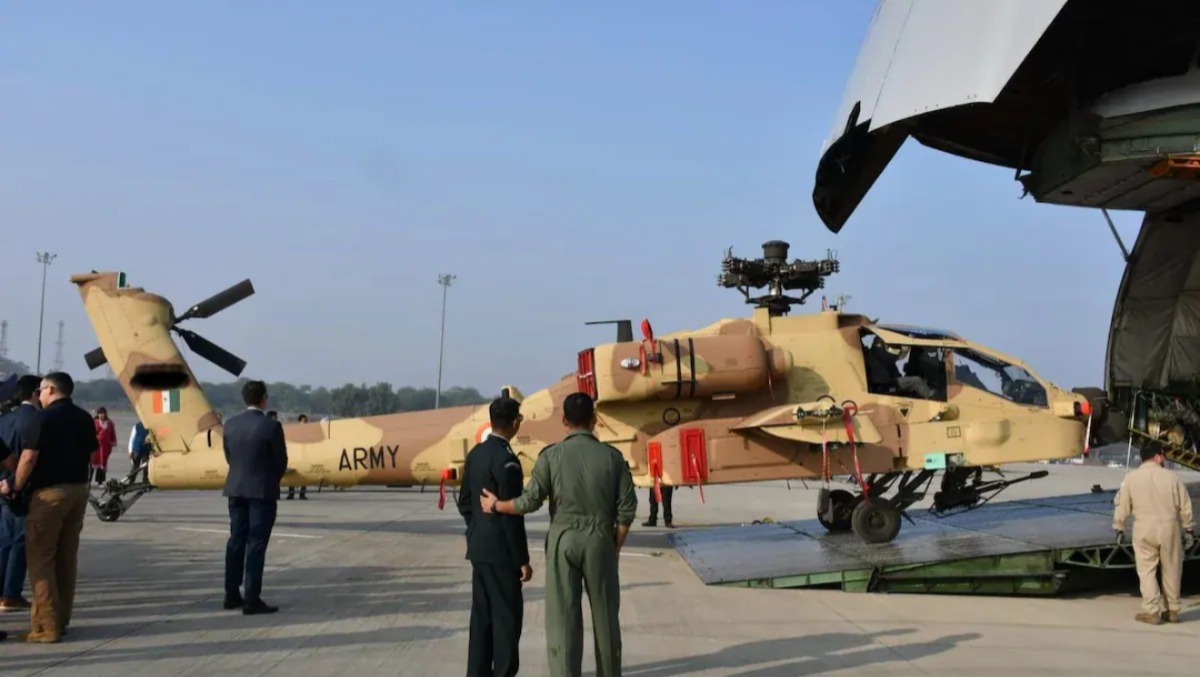
New Delhi: The Indian Army has received the final three Boeing Apache AH-64E attack helicopters, completing the delivery of the six-aircraft order. The helicopters will be deployed to the 451 Army Aviation Squadron in Jodhpur following assembly, joint inspections, and other formalities. They were transported to India aboard an Antonov An-124 aircraft.
The first three Apache helicopters arrived in July this year, with the remaining three arriving recently. Their induction marks a significant enhancement of the Army Aviation Corps’ operational capabilities, particularly in strike and reconnaissance roles. The helicopters made their operational debut during Exercise Maru Jwala, part of the larger tri-services drill, Exercise Trishul.
Alongside the Apaches, the Army is also set to induct 90 homegrown Light Combat Helicopters (LCH) Prachand, while continuing to operate the weapon-equipped version of the Advanced Light Helicopter (ALH), known as Rudra.
The induction of the AH-64E helicopters had faced delays, with initial deliveries expected in early 2023. The first batch eventually arrived in July 2025, with the second batch following now. The Indian Army has formally inducted the helicopters into its aviation fleet, calling the arrival a “milestone moment” that will bolster operational capabilities significantly.
The Indian Air Force already operates 22 Apache helicopters in Ladakh and western sectors. The AH-64E is the most advanced version of the Apache, designed for modern Multi-Domain Operations. It features a Longbow fire control radar providing 360-degree coverage, a nose-mounted sensor suite for target acquisition, night vision capabilities, and a range of weapons including Hellfire missiles, 70 mm Hydra rockets, Stinger air-to-air missiles, and a 30 mm chain gun with 1,200 rounds.
The AH-64E Version 6 incorporates upgrades to sensors, software, and weapons systems, enabling it to operate in highly contested and complex battlefields. It is optimized for joint operations, integrating onboard and offboard sensors, long-range stand-off weapons, and network connectivity, making it a fully integrated attack helicopter for modern warfare.
The induction of these helicopters represents a major step forward in strengthening India’s attack helicopter fleet and enhancing the Army Aviation Corps’ capability to respond to emerging threats across multiple domains.
Sorry, there was a YouTube error.