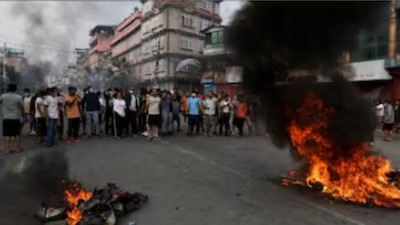
New Delhi: As Nepal faces unprecedented nationwide protests led by its youth against censorship, corruption, and political instability, thousands of Indian nationals living and working in the country are now trapped in an escalating crisis. With violence spreading across the Kathmandu Valley and other regions, Indian citizens are facing economic losses, security threats, and severe disruptions to their daily lives.
Sources confirm that Indian-owned commercial establishments have been among the worst affected. In Kathmandu and Pokhara, malls like Civil Mall and KL Tower, along with trading houses in New Road, were attacked in incidents of arson and looting between September 7 and 9. Early reports suggest losses worth several crores of Nepali rupees.
In Sundhara Market, at least three Indian-owned shops were burned down, intensifying fears among entrepreneurs. Many Indian restaurateurs, hoteliers, and shopkeepers have shut down operations indefinitely. Over 400 small businesses have been impacted, with daily losses estimated between ₹15-20 crore.
The closure of Tribhuvan International Airport since September 9 has left around 2,500 Indian tourists and business travellers stranded, including elderly pilgrims and medical patients. Flights from Kathmandu were cancelled, with only two out of six scheduled return flights operating, leaving nearly 700 passengers stuck.
A group of 130 pilgrims from Isha Foundation, visiting Kailash Mansarovar, are among those trapped. “We don’t know what to do. The airport gates are shut, and there’s no food or water,” said Rajani Maski, one of the stranded pilgrims from Bengaluru.
With highways blocked and curfews in place, evacuation by road is nearly impossible.
Alongside physical threats, Indian nationals are also facing a surge in online harassment and misinformation. Intelligence sources reveal that Pakistan’s Inter-Services Intelligence (ISI) and affiliated groups are amplifying anti-India narratives, falsely accusing India of supporting Nepal’s monarchy revival.
Pro-monarchy protesters waving Indian flags during demonstrations have been flagged as deliberate “false flag” operations aimed at provoking unrest. These campaigns are fueling suspicion and hostility, particularly among digitally mobilised youth.
India’s Ministry of External Affairs (MEA) has issued travel advisories and emergency helpline numbers for citizens in Nepal. However, with airport closures and communication disruptions, helping stranded individuals remains difficult.
Officials acknowledge that hundreds of Indian workers in sectors like IT and cross-border trade are unable to reach their families due to internet blackouts.
Political Vacuum and Growing Anti-India Sentiment
The resignation of Nepal’s Prime Minister KP Sharma Oli following deadly protests has left a leadership void, further complicating the situation. Anti-India sentiment is on the rise, and external forces are exploiting the unrest to create chaos.
With 15-20% of the Indian community in Nepal concentrated in the most affected areas, safeguarding their well-being has become an urgent priority.
For now, India’s diplomatic efforts are focused on ensuring the safety and evacuation of its citizens. Officials warn that unchecked misinformation could lead to more violence if left unaddressed.
As the situation remains tense, the coming days will test the ability of India and Nepal to navigate the crisis and protect vulnerable communities caught in the crossfire.