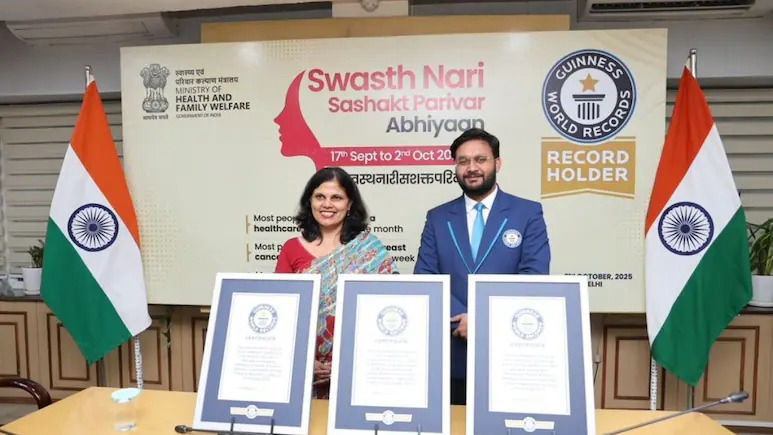
New Delhi: India has earned global recognition with three Guinness World Records under its nationwide women’s health initiative, Swasth Nari, Sashakt Parivar Abhiyaan (SNSPA). The campaign, aimed at strengthening preventive and women-centric healthcare, achieved remarkable participation across the country.
The records were awarded for the highest number of people registering on a healthcare platform in a month with more than 3.21 crore participants, the largest number of online breast cancer screenings in a week with over 9.94 lakh sign-ups, and the most online vital signs screenings at the state level in a week with 1.25 lakh participants.
According to the Union Health Ministry, the campaign covered every district in India, organizing 19.7 lakh health camps and reaching over 11 crore people through various health services. During this period, screenings were conducted for 1.78 crore individuals for hypertension, 1.73 crore for diabetes, and nearly 70 lakh for oral cancer. The initiative also recorded 62.6 lakh antenatal check-ups, 1.43 crore vaccinations, and 1.51 crore anaemia tests.
Women’s health received major attention with 85.9 lakh tuberculosis screenings, 10.2 lakh for sickle cell disease, and over 2.14 crore participants joining wellness and counselling sessions. More than 2.68 lakh Nikshay Mitra volunteers also registered to support tuberculosis patients under the National TB Elimination Programme, with active involvement from My Bharat volunteers.
The campaign was a collaborative effort involving over 20 central ministries, government bodies, educational institutions, and private organisations, reflecting a whole-of-government approach. Lawmakers and officials at all levels also took part in the effort.
Prime Minister Narendra Modi said the initiative symbolises the nation’s commitment to women’s well-being, noting that “healthy mothers and sisters are the foundation of a strong nation.”
Launched on September 17 and held until October 2 as part of Poshan Month, SNSPA brought together over five lakh Panchayati Raj representatives, 1.14 crore students, 94 lakh self-help group members, and around five lakh participants from community organisations, marking a milestone in India’s blend of public health outreach, digital innovation, and social participation.