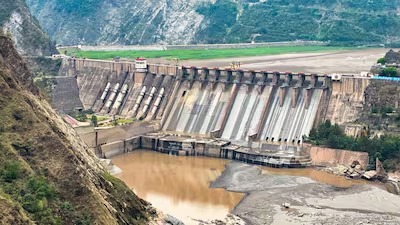
New Delhi: India has shifted its approach to the Indus Waters Treaty from restraint to strategic execution after placing the agreement in abeyance in April 2025 following the Pahalgam terror attack. By treating the treaty as suspended, New Delhi has stopped sharing technical data and prior notifications with Pakistan regarding new and existing projects on the Chenab River, marking a significant change in policy.
The Indus Waters Treaty, signed in 1960 between India and Pakistan with the World Bank as mediator, divided the six rivers of the Indus basin. The eastern rivers were allotted to India for unrestricted use, while the western rivers were allocated to Pakistan with limited non consumptive rights for India, mainly for run of the river power generation. The pact also created a Permanent Indus Commission and a dispute resolution mechanism.
With the treaty effectively on hold, India has accelerated a series of hydropower projects in Jammu and Kashmir. The most prominent is the Sawalkote Hydroelectric Project on the Chenab, which recently received international tenders worth more than five thousand crore rupees. The project, spread over two stages, will have a total capacity of 1,856 megawatts and is expected to become the largest power facility in the region within nine years.
Other projects have also been put on a fast track schedule. The Pakal Dul project in Kishtwar, India’s first storage dam on a western river, has been given a non negotiable deadline of December 2026. Once operational, it will allow India to regulate the timing of water flows into Pakistan, a capability that has long been a sensitive issue.
The Kiru and Kwar run of the river projects are also being expedited with firm commissioning timelines, while the long disputed Ratle project is moving ahead as a sovereign decision despite objections from Pakistan. Dulhasti Stage Two has received environmental clearance under the position that treaty notification requirements are currently void.
Alongside new construction, India has begun infrastructure upgrades at existing Salal and Baglihar dams, including desilting and reservoir enhancement to improve power generation. Feasibility studies are under way for a canal to divert surplus Chenab waters toward the Ravi and Beas systems to support Punjab and Rajasthan.
These developments have raised concern in Pakistan, which depends heavily on the western rivers for agriculture and drinking water. A large part of its irrigation network relies on flows that originate from Indian territory. India, however, maintains that its actions are a direct consequence of cross border terrorism and the changed security environment.