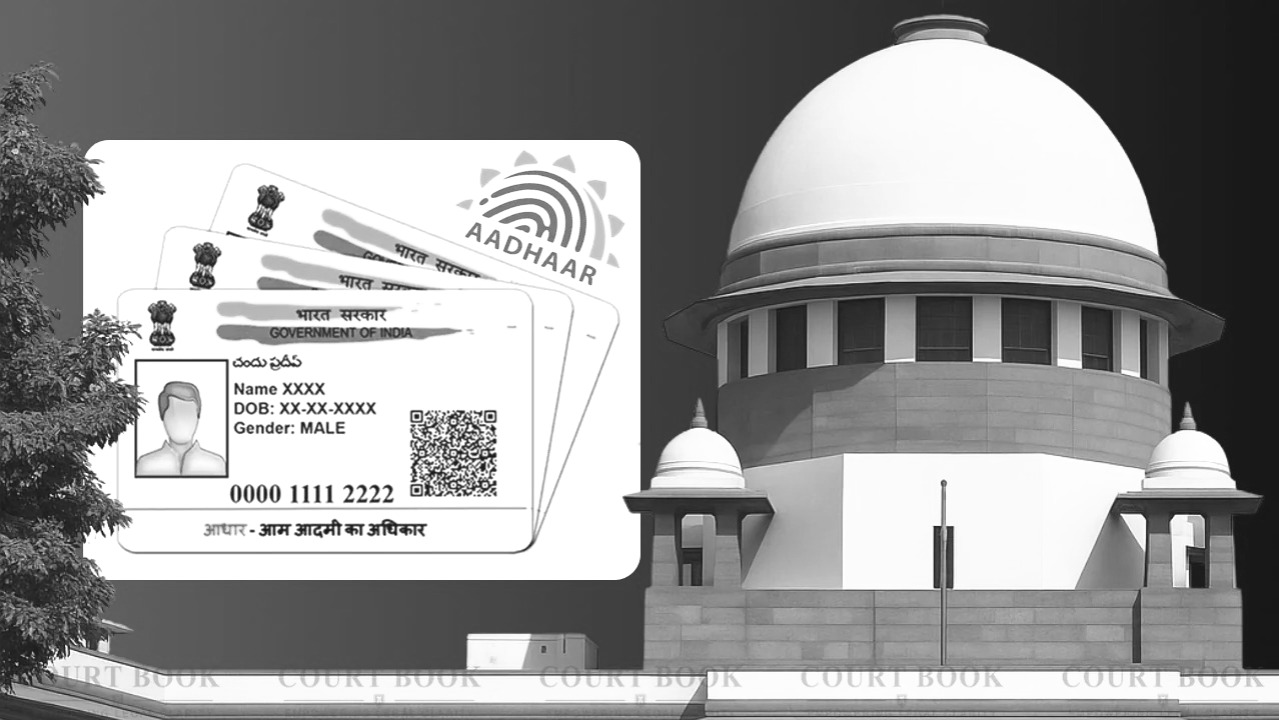
New Delhi: The Supreme Court raised an important query on the role of Aadhaar in determining voter eligibility, observing that individuals who are not Indian citizens but have managed to obtain Aadhaar cards cannot automatically be treated as eligible voters. The court reiterated that Aadhaar is designed to facilitate access to welfare schemes and cannot be considered proof of citizenship.
A bench led by the Chief Justice, while hearing petitions against the Election Commission’s Special Intensive Revision of electoral rolls in several states, emphasised that Aadhaar is only one among multiple documents that may be submitted during voter registration. The court noted that if a name is removed from the electoral roll, the individual must be given proper notice and an opportunity to respond. It also referred to provisions of the Aadhaar Act, which clearly state that the document does not confer citizenship or domicile.
The bench questioned the implications of treating Aadhaar as a basis for voting rights and used the example of a person from a neighbouring country who may have obtained the document only to access ration benefits. It pointed out that such circumstances highlight the need for a careful and lawful verification process.
The court also affirmed that the Election Commission has full authority to scrutinise documents submitted with Form 6 applications for inclusion in voter lists. The institution, it said, cannot function merely as a channel that accepts submissions without verification.
A schedule was set to hear petitions specifically challenging the revision process in Tamil Nadu, Kerala and West Bengal. The Election Commission has been asked to submit its responses by December 1, after which petitioners may file their rejoinders.
During the proceedings, concerns were raised about the burden placed on ordinary voters by the revision exercise. It was argued that many citizens, particularly those who are illiterate, may face difficulties completing paperwork required to maintain their names on the rolls. The court was urged to prioritise the protection of constitutional rights while considering administrative procedures.
The bench also noted the necessity of removing entries of deceased voters, pointing out that electoral lists are accessible in local bodies and online. The matter will be taken up again as the hearing continues.
Sorry, there was a YouTube error.