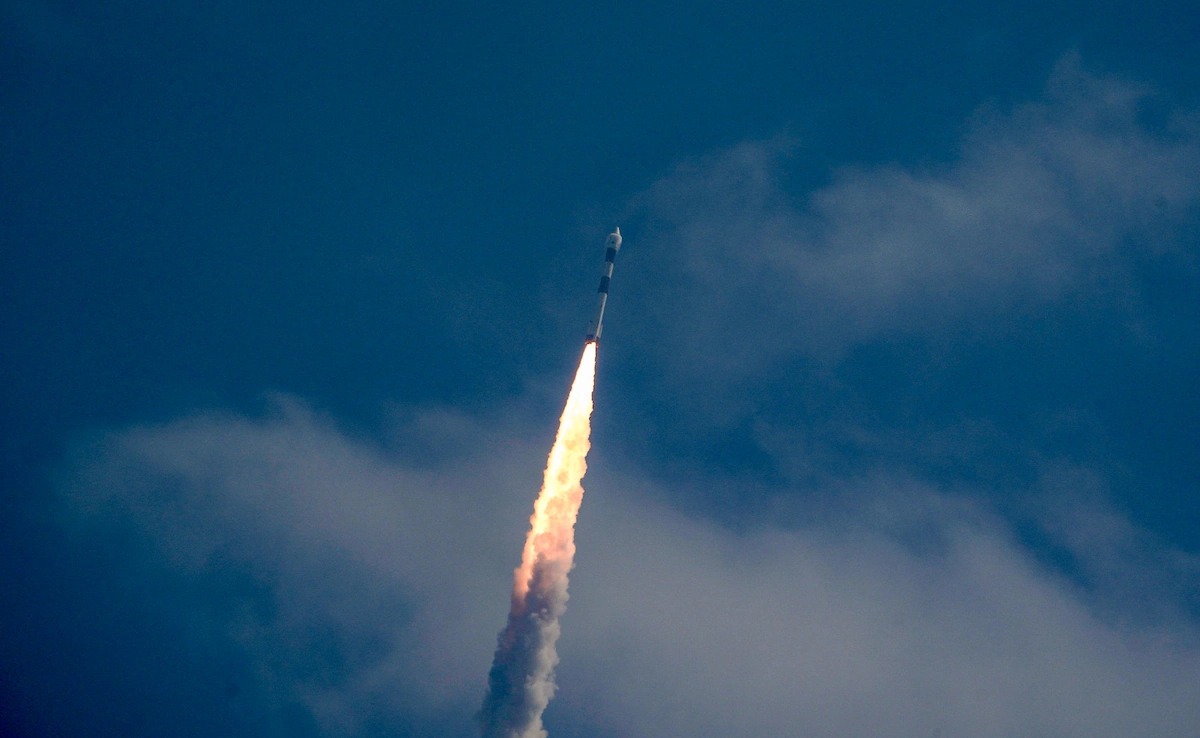
New Delhi: India’s Polar Satellite Launch Vehicle (PSLV) suffered a significant setback on Monday when its PSLV-C62 mission failed to deploy 16 satellites due to an anomaly near the end of its third stage. The 44.4-metre, four-stage rocket lifted off at 10:18 am from the Satish Dhawan Space Centre in Sriharikota, marking ISRO’s first launch of 2026.
While the first two stages of the vehicle performed as expected, disturbances in the third stage caused a deviation from the planned trajectory. ISRO Chairman V Narayanan confirmed the anomaly, stating that the mission “could not proceed in the expected path” and that detailed analysis is underway to identify the cause.
The PSLV-C62 payload included India’s 1,696 kg Earth observation satellite EOS-N1, the classified hyperspectral surveillance satellite Anvesha developed by DRDO, and a KID capsule intended for re-entry. Multiple commercial and academic satellites were also on board, including Dhruva Space’s MOI-1, Thybolt-3, and LACHIT, Chennai-based OrbitAid Aerospace’s AyulSat, Gujarat-based Sanskarsat, Nepal-India collaborative Munal, and several international co-passenger satellites from Spain, France, and Brazil.
The failure has affected both strategic and commercial interests. Anvesha was expected to enhance India’s surveillance and material identification capabilities, while Dhruva Space and other private entities had integrated multiple technology demonstration and AI-enabled payloads. Brazilian satellites on the mission aimed to provide IoT monitoring, radiation sensing, and maritime rescue services.
The incident echoes a similar third-stage failure during the PSLV-C61 mission in May 2025, raising questions about recurring anomalies in critical missions. While ISRO emphasizes ongoing investigation, experts note that recent setbacks disproportionately involve defence or national-security payloads, prompting scrutiny over reliability and system resilience.
Private space companies have expressed measured optimism. Dhruva Space emphasized its readiness to re-manifest payloads and continue operations, while Skyroot Aerospace highlighted the importance of learning from setbacks to strengthen India’s space ecosystem.
ISRO’s immediate focus is a thorough analysis of the third-stage anomaly, implementing corrective measures, and restoring confidence in the PSLV for upcoming commercial and strategic launches. The episode serves as a stark reminder of the challenges inherent in space missions and the need for rigorous testing, transparency, and resilience in India’s ambitious space program.
1
/
8


#JustCasual With Sadanand Shet Tanavade | “Special Status Not Possible for Goa”
#JustCasual With Utpal Parrikar | “Ready To Align With Like-Minded People For CCP”
#JustCasual With Yuri Alemao | FROM COCKPIT TO ASSEMBLY FLOOR, Yuri Alemao’s TURBULENT life
#JustCasual With Amit Patkar | “Amit Patkar Ko Gussa Kyun Aata Hai?”
#JustCasual With Joshua De Souza Speaks Candidly on Mapusa, Politics & Michael Lobo,”
#JustCasual With Archit Shantaram Naik GPYC Chief “NOT A NEPO KID, WORKED HARDTO REACH HERE
1
/
8