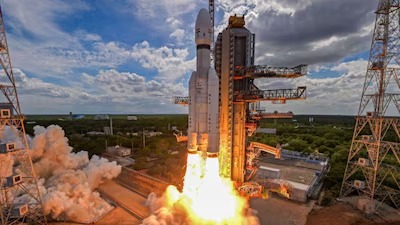
New Delhi: The Indian Space Research Organisation has achieved a major milestone for the Chandrayaan 4 mission by identifying a safe landing area for the Vikram lander in the Moon’s southern polar region. The discovery moves India closer to its first mission aimed at collecting lunar samples and returning them to Earth.
Scientists have zeroed in on a relatively flat and stable location near the Mons Mouton mountain, which is being considered the most suitable site for touchdown. The selection was made after an extensive study of high resolution images captured by the Chandrayaan 2 orbiter. Researchers carried out a detailed evaluation of the terrain and identified an area of nearly one square kilometre that meets the strict safety requirements for landing.
Chandrayaan 4 is regarded as the most complex lunar project undertaken by India so far. The mission will consist of multiple components, including a propulsion module, descender, ascender, transfer module and a re entry module. According to the planned sequence, the Vikram lander will descend to the lunar surface, where robotic systems similar to the Pragyan rover will collect soil and rock samples. These will then be transported to lunar orbit and eventually brought back to Earth.
Choosing the landing location has been the most challenging aspect of the mission. Engineers have set tough conditions for the site, such as a ground slope below 10 degrees, minimal large rocks, adequate sunlight for nearly 12 days, clear radio communication with Earth and a surface with very few craters.
Earlier assessments had pointed to several possible regions near the south pole. In the latest phase, five locations around Mons Mouton were examined in depth. One area was rejected due to permanent darkness, while four others were analysed using digital elevation models with a resolution of 32 centimetres. These studies focused on slope, height variation, sunlight availability and overall risk factors.
Among the shortlisted options, the site labelled MM 4 emerged as the safest choice. Situated at 84.289 degrees south latitude and 32.808 degrees east longitude, it has an average slope of about five degrees and offers sufficient sunlight for powering the lander. The overall risk level was calculated at less than 10 percent, making it the most balanced option compared to other candidates.
Experts believe the study highlights the importance of advanced imaging technology in making precise landing decisions. If approved by the mission committee, this region could become the historic location from where India attempts its first lunar sample return, placing the country among an elite group of spacefaring nations.
Sorry, there was a YouTube error.