Team Goemkarponn
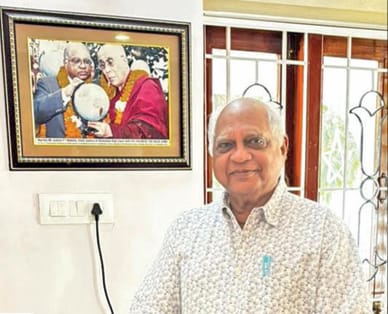
Panaji: Former Chief Justice of the Allahabad High Court and retired Bombay High Court judge Justice Ferdino Rebello has called for an immediate suspension of all land-use change approvals granted under Section 39-A of the Goa Town and Country Planning (TCP) Act and demanded a review of every permission already issued under the provision.
Writing in his capacity as convenor on behalf of Goans who have adopted a 10-point charter, Justice Rebello, in a sharply worded letter dated February 6 to the Chief Town Planner (Planning) and the Town and Country Planning Board, described Section 39-A as “manifestly arbitrary” and alleged that it is being used to facilitate unlawful conversion of agricultural and comunidade lands under the pretext of planning permissions.
Section 39-A, introduced through Amendment Act No. 3 of 2024, authorises the Chief Town Planner, with government directions and approval of the TCP Board, to modify the Regional Plan or Outline Development Plan for zoning changes, following a 30-day public notice and subject to the exclusion of eco-sensitive areas. Justice Rebello, however, argued that the safeguard in sub-section (2)—which claims that such changes should not alter the overall character of the plan—is merely a “colourable exercise of legislation” intended to legitimise conversions that are otherwise illegal.
Quoting official data, he pointed out that 423 applications seeking zoning changes covering over 31.54 lakh square metres have already been submitted under Section 39-A, with 163 final notifications issued for nearly 12.7 lakh square metres of land.
Tracing the legislative framework in Goa, Justice Rebello noted that laws such as the Goa Agricultural Tenancy Act, 1964, the Goa Land Use (Regulation) Act, 1991, and the Goa Restrictions on Transfer of Agricultural Land Act, 2023 were enacted specifically to protect agricultural land—especially paddy fields—from non-agricultural use. He maintained that recent amendments to the TCP Act, including Sections 17(2) and 39-A, dilute these safeguards despite Regional Plans having already attained finality.
A significant portion of the letter deals with comunidade lands, governed by the Code of Comunidades and the Portuguese Civil Code. Justice Rebello explained that most comunidade properties were historically granted for agricultural or horticultural purposes through leases, emphyteusis or licences, and later came under the protection of tenancy laws. Referring to Article 31-A of the Code of Comunidades, inserted in 2025, he underlined that land granted for a specific purpose cannot be diverted to any other use, regardless of provisions in the TCP Act or other laws. Any such violation, he warned, would result in the land reverting to the comunidade.
Justice Rebello also raised concerns over what he described as manipulation of revenue records and false declarations by tenants, landlords and builders to erase tenancy history reflected in Form I and XIV and comunidade records like Tombo I and Tombo II. Highlighting the apparent conflict between the 1991 Land Use Act and the 2023 Agricultural Land Act, he asserted that the overriding clauses in earlier legislation prevail over settlement zoning shown in Regional Plans, making conversion of tenanted paddy fields illegal even if they fall within settlement areas.
In his letter, Justice Rebello urged planning authorities to keep all pending Section 39-A applications in abeyance until the provision is repealed, reopen and cancel approvals already granted, and formally caution officials and board members that they lack jurisdiction to permit conversion of agricultural land. He further called for departmental inquiries and criminal proceedings against those involved in granting illegal permissions and sought circulation of his letter to all TCP Board members and regional planning bodies.
He cautioned that officials and board members who participated in granting such permissions could face legal action, noting that earlier scrutiny of applications under Section 17(2) had already exposed widespread irregularities.