Team Goemkarponn
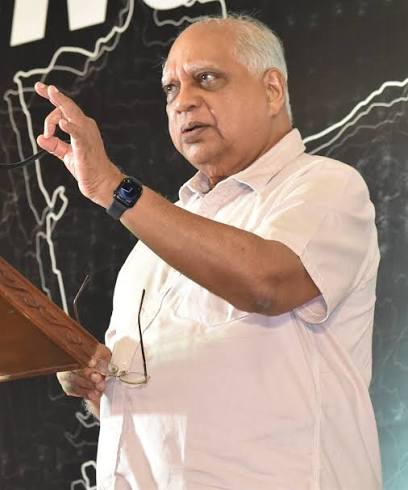
PANAJI: Stepping up the fight against rampant hill cutting and the filling of low-lying lands in Goa, retired Allahabad High Court Chief Justice Ferdino Rebello has announced plans to initiate legal action, alleging that such permissions are being granted without any valid legal framework.
Addressing a public meeting on Thursday, Justice Rebello said he would write to the Secretary of the Town and Country Planning (TCP) Board and the Chief Town Planner (Land Use), demanding an immediate halt to all permissions for hill or slope cutting and land filling, regardless of gradient. He cited the absence of properly framed rules under the Goa Town and Country Planning Act to regulate such approvals.
The letter, scheduled to be dispatched on Friday, will also seek stop-work notices for all ongoing projects where such permissions have already been granted, and suspension of approvals in cases where occupancy certificates are yet to be issued. Justice Rebello made it clear that the letter itself would serve as the foundation for a writ petition to be filed before the Bombay High Court at Goa. “We will not wait for the government’s response. The letter will be the basis of our writ petition,” he told the media, adding that a senior lawyer from Mumbai has agreed to argue the matter.
He said the proposed legal action would greatly strengthen the case of villagers from Sancoale who are opposing large-scale housing projects in their area. The draft of the letter was unanimously approved at a packed public meeting held at the MCC Hall in Margao on Thursday evening, with participants authorising Justice Rebello to proceed.
In the letter, Justice Rebello has warned that officers who granted such permissions could be held personally accountable, especially for allegedly concealing from the High Court that approvals were earlier granted strictly on the basis of Survey of India (SOI) topographical maps. “There is a demand from the people of Goa for disciplinary action against officers who have connived in granting permissions contrary to SOI maps. This issue will be pursued before all competent authorities if immediate corrective steps are not taken,” the letter states.
Justice Rebello pointed out that although amended Sections 17A and 17B of the Planning Act vest powers in the Chief Town Planner to permit hill cutting and land filling, no rules have been framed under Section 140 of the Act to prescribe the manner in which such permissions can be granted. He also noted that the government has not issued any notification under Articles 154 and 166 of the Constitution to authorise such actions through executive power.
He further questioned the legality of guidelines purportedly framed by the TCP Board. Referring to a resolution passed at the Board’s 90th meeting on December 15, 2000, Justice Rebello said the Board had no authority under Section 17A to issue guidelines for hill cutting, rendering them illegal.
He recalled that on January 27, 2010, an Explanatory Memorandum on Section 17A, signed by the then Chief Town Planner, clearly laid down that slope analysis must be based on contour data derived from Survey of India maps—authenticated and restricted documents of the Government of India. The memorandum also detailed the method for calculating slopes to determine whether the 25 per cent gradient limit was breached. “This system of granting permissions strictly on the basis of SOI topographical sheets was consistently followed,” he said.
However, Justice Rebello alleged that in September 2023, the Chief Town Planner placed new guidelines for cutting of sloping land before the TCP Board, which were approved in its 189th meeting held in August 2023. He contended that this approval was again illegal, as the TCP Board has no power to frame such guidelines, and that the revised norms ignored the SOI-based slope analysis method endorsed in 2010.
“I am informed that after the illegal order of September 6, 2023, gradients are no longer being calculated using SOI topographical sheets but on the basis of private contour plans submitted by architects,” Justice Rebello said. “This is completely unlawful and prima facie suggests a quid pro quo.”
He asserted that unless immediate corrective action is taken, the matter will be pursued rigorously before the High Court and other appropriate authorities.