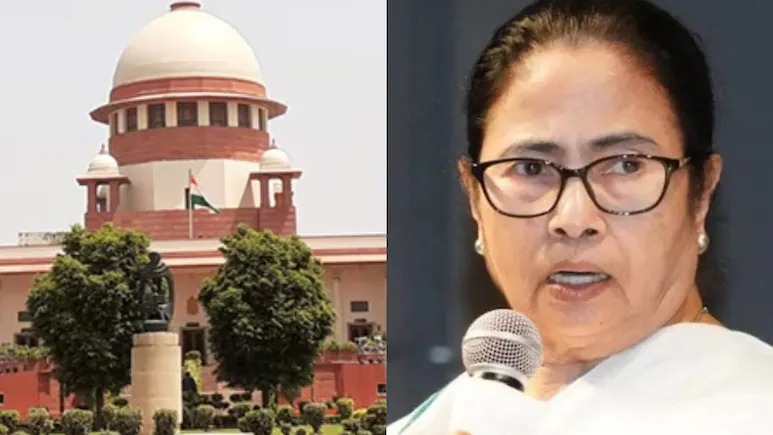
New Delhi: West Bengal Chief Minister Mamata Banerjee’s decision to personally argue a case before the Supreme Court has generated intense political discussion in the state, with supporters viewing it as a bold stand and critics calling it political theatre. For the first time in India’s legal history, a sitting chief minister appeared as a party in person to challenge the Election Commission, making sharp allegations against the poll body.
During the hearing before the Chief Justice of India, Banerjee accused the Election Commission of acting unfairly towards West Bengal. She claimed that lakhs of voters were removed from the electoral rolls without being given an opportunity to submit required forms. According to her, the Special Intensive Revision process was being used selectively against Bengal and micro observers had been appointed only in the state, a move she described as discriminatory.
The eight minute intervention in the packed courtroom quickly became the centre of attention in Kolkata’s political circles. With assembly elections approaching, analysts believe the chief minister sought to project herself as a fighter taking on national institutions for the rights of Bengal’s people. Her appearance in Delhi was widely interpreted as an attempt to shape the narrative ahead of a tough contest between the ruling Trinamool Congress and the Bharatiya Janata Party.
Political experts offered mixed assessments of the move. Some felt that Banerjee successfully revived her image as a street level leader willing to confront powerful opponents. Others pointed out that electoral battles are ultimately decided by local issues such as employment, governance and corruption allegations, which continue to trouble her government after more than a decade in power.
The opposition reacted sharply. Former state BJP president Dilip Ghosh mocked the chief minister, suggesting she was searching for a new role after sensing defeat in the next election. Congress leaders in Bengal described the court appearance as an attempt to divert attention from administrative failures. Trinamool representatives, however, praised her courage and said the entire country had witnessed her challenge to what they termed an unjust system.
Banerjee, who holds a law degree from Kolkata, last practised actively nearly two decades ago and has never argued in the Calcutta High Court. Since she is not enrolled with the Supreme Court bar, she appeared as a litigant in person. The unusual sight of the chief minister in a lawyer’s gown drew reactions from across the political spectrum, including praise from some opposition leaders outside Bengal.
Whether the dramatic courtroom moment translates into electoral advantage remains uncertain. Observers note that while the episode has strengthened her political optics, the coming months will test her government on everyday concerns of voters. The case is expected to continue next week, keeping the spotlight firmly on Bengal’s volatile political landscape.
Sorry, there was a YouTube error.