Team Goemkarponn
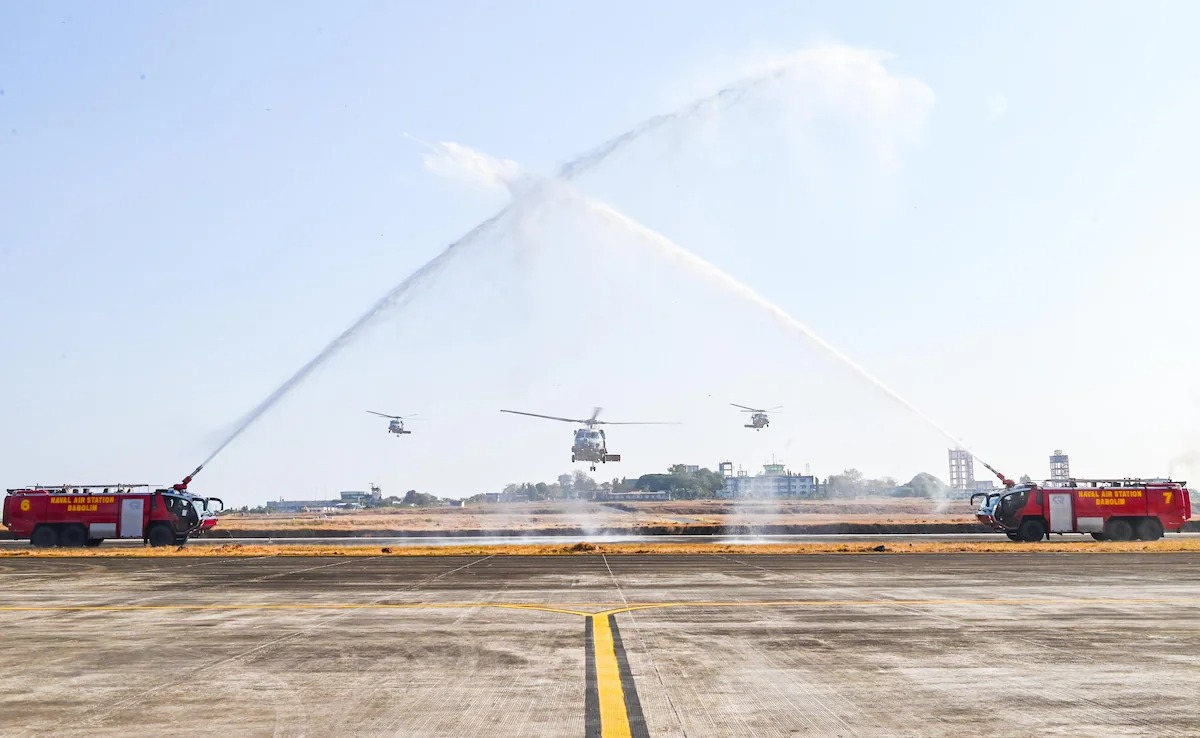
Panaji: The Indian Navy on Wednesday commissioned INAS 335 ‘Ospreys’, its second squadron of MH-60R Romeo anti submarine warfare helicopters, at INS Hansa in Goa, marking a significant step in strengthening maritime security along the western seaboard. The squadron was formally inducted in the presence of Chief of Naval Staff Admiral Dinesh Tripathi and was accorded a ceremonial water cannon salute.
Addressing the gathering, the Navy chief highlighted the evolving and increasingly complex maritime environment, shaped by shifting geopolitics, rapid technological change, and a broader spectrum of threats. He underlined that strengthening maritime security and deterrence remains central to protecting sea lines of communication and India’s expanding national maritime interests.
The induction of the MH-60R helicopters as the first operational squadron on the western coast was described as a major milestone for the Navy. The aircraft are capable of multi role operations, including anti submarine and anti surface warfare, surveillance, logistics support, and search and rescue missions, significantly enhancing fleet readiness and operational reach.
The commissioning ceremony held added historical significance, coinciding with 75 years since the approval of India’s Fleet Air Arm, a decision that transformed naval aviation into a critical component of maritime power. The occasion also aligned with the anniversary of the commencement of Operation Vijay in December 1961, when Indian naval forces played a key role in the liberation of Goa, supported by naval aviation assets positioned offshore.
Highlighting future capabilities, the Navy chief said the force is progressing with the acquisition of 15 MQ-9B Sea Guardian remotely piloted aircraft, which will strengthen persistent maritime surveillance and domain awareness. He also emphasised continued focus on enhancing shipborne aviation, both fixed wing and rotary wing, to ensure sustained operational effectiveness at sea.
The recent contract for 26 Rafale-M carrier borne fighter aircraft was cited as another important step, expected to boost long range maritime strike capability, fleet air defence, and land attack operations. These assets will be complemented by rotary wing platforms and uncrewed aviation systems to extend surveillance and combat reach.
Senior officers of the Western Naval Command and Goa Area were present at the ceremony, which concluded with a march past by the newly commissioned squadron, often referred to as the Navy’s “flying destroyers.”
Sorry, there was a YouTube error.