New Delhi:
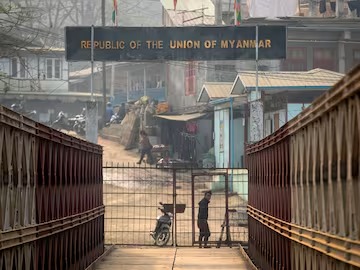
The Modi government has started the process to build a fence along the largest stretch of the India-Myanmar border so far, covering a distance of 83 km in Arunachal Pradesh.
Sources has accessed documents related to the development. The Border Roads Organization (BRO) will be undertaking the construction.
Currently, only 10 km of the India-Myanmar border is fenced near Moreh in Manipur, while fencing of another 20 km in Manipur has been recently completed. The latest project, spanning 83 km in Arunachal Pradesh, will be the largest border fencing project yet on the India-Myanmar border. According to details obtained by CNN-News18, this project will cover an 83-km stretch between Border Post (BP) Number 168 to BP-175 in Arunachal Pradesh.
The BRO last week asked the technical consultants to prepare a detailed project report (DPR) and feasibility study, and provide pre-construction activities for the erection of the fence and a track along the 83-km stretch of the Indo-Myanmar border in Arunachal Pradesh. The home ministry had also recently asked Manipur and Arunachal Pradesh to speed up the preparation of DPRs for fencing projects and expedite the construction of the fencing.
Arunachal Pradesh shares the longest boundary with Myanmar at nearly 520 km, followed by Mizoram at 510 km, Manipur at 398 km, and Nagaland at 215 km. The total Indian border with Myanmar is 1,643 km, which is mostly unfenced.
THE URGENCY
For over a year now, Manipur has been rocked by ethnic violence and tensions, which have reportedly claimed over 200 lives. This prompted the government to first scrap the Free Movement Regime (FMR) between India and Myanmar this year, and approve in-principle a Rs 31,000-crore project to fence the entire Indo-Myanmar border.
Under the FMR, citizens of both the countries could venture 16 km into each other’s territory without any documentation.
The border is known for the smuggling of arms, ammunition, and narcotics, and the porous border is considered the root cause of the ethnic violence in Manipur. The porous border is also believed to have led to a massive influx of illegal immigrants from Myanmar, leading to demographic changes in Manipur and illegal poppy plantations in the hilly regions of Manipur. Consequently, the home ministry took the decisions to start the fencing and scrap the FMR.
Tribal organisations in Manipur, including the Indigenous Tribal Leaders’ Forum (ITLF), however, have been objecting to the fencing project, saying it would hurt the social, cultural, and economic ties between tribal communities who live on both sides of the border.
Recently, Bharatiya Janata Party (BJP) ally NPF also opposed the fencing of the India-Myanmar border in the Naga-dominated areas of Manipur.