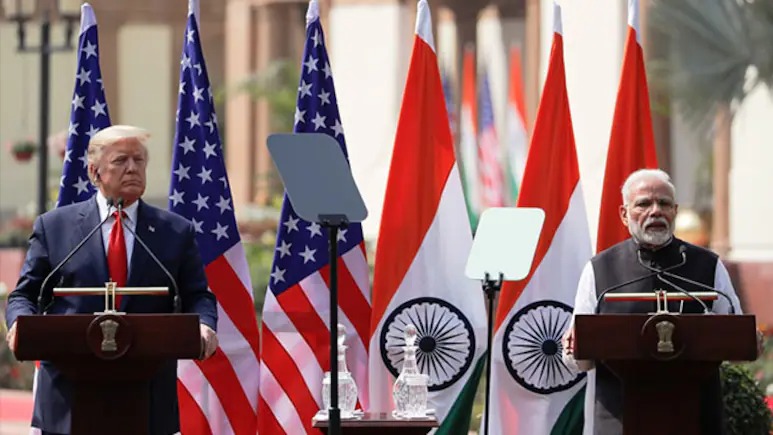
New Delhi: In a bold diplomatic move, Prime Minister Narendra Modi made it categorically clear to former US President Donald Trump that India has never accepted—and will never accept—any foreign mediation on its disputes with Pakistan. The 35-minute phone call, initiated by Trump, served as an opportunity for Modi to bust what New Delhi sees as a false narrative that the United States played a role in negotiating a ceasefire during India’s Operation Sindoor.
The conversation also underscored Modi’s assertiveness on the world stage. Despite Trump’s personal request, Modi declined to make a stopover in the US while returning from the G7 Summit in Canada, choosing instead to honour a scheduled diplomatic visit to Croatia—marking the first-ever visit by an Indian Prime Minister to the Balkan nation.
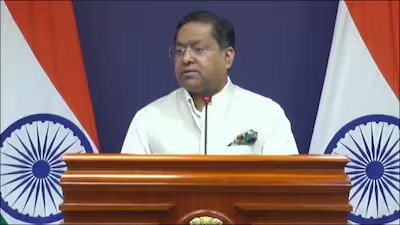
According to Foreign Secretary Vikram Misri, Modi used the call to directly reject Trump’s earlier claims that a ceasefire between India and Pakistan was brokered through backchannel talks involving the US and trade diplomacy.
“At no time, at any level, were there any discussions on an India-US trade deal or any mediation regarding Pakistan,” Modi told Trump firmly. Misri added that the ceasefire was discussed solely between the Indian and Pakistani armies through existing military channels, and only after a formal request by Pakistan.
This clarification comes amid criticism from India’s opposition parties, especially the Congress, who questioned Modi’s silence over Trump’s repeated remarks about playing a mediator’s role. Modi’s strong response is being seen as a strategic move to silence domestic political detractors.
The phone call followed the cancellation of a scheduled in-person meeting on the G7 sidelines due to Trump’s early return to the US. It was also the first direct communication between the two leaders since the April 22 terror attack in Pahalgam, which killed 26 tourists and was claimed by a Pakistan-backed terror group.
Modi conveyed that India now considers terrorism not as a proxy threat, but as a direct act of war. He informed Trump that India’s retaliatory Operation Sindoor continues, having already targeted nine high-value terror infrastructure locations in Pakistan and Pakistan-occupied Kashmir with precision.
“India’s actions were deliberate, proportionate, and non-escalatory,” Modi told Trump, adding that India had made it clear that it would respond to any aggression with overwhelming force. He also cited the events of May 9-10, when Pakistan was reportedly preparing a major retaliatory strike. US Vice President JD Vance had warned Modi of the development, to which the PM responded: “If Pakistan attacks, India will retaliate with even greater force.”
According to Misri, India’s counterstrike left several Pakistani military airbases inoperable and caused substantial damage to its defence infrastructure. It was only after this that Pakistan initiated a request for ceasefire.
Modi’s refusal to accept Trump’s invite for a brief US stopover is being viewed in diplomatic circles as an unusual but telling decision. “It is rare for a country to decline a US invitation,” said a senior official. However, Modi chose to stand by his commitment to visit Croatia on June 18—underscoring India’s growing strategic outreach to newer partners and its assertion of sovereign diplomatic priorities.
Misri confirmed that while Trump had proposed a stopover meeting, Modi declined due to prior commitments. Both leaders agreed to meet in the near future instead.
Global Affairs and QUAD Cooperation
Beyond bilateral matters, Modi and Trump also discussed key international developments, including the Iran-Israel conflict and the ongoing Russia-Ukraine war. Both leaders agreed on the importance of direct dialogue between Moscow and Kyiv for lasting peace.
They also touched upon the evolving Indo-Pacific landscape and the importance of the QUAD grouping. Modi extended an invitation to Trump to attend the next QUAD summit in India, which Trump accepted.
India’s Diplomatic Stand Reasserted
The call reaffirmed India’s long-held position that its issues with Pakistan are bilateral and not subject to third-party involvement. Misri emphasized: “India has never accepted mediation, does not accept it, and will never accept it. There is complete political consensus on this issue within India.”
By setting the record straight and rejecting both mediation and diplomatic detours, PM Modi signaled India’s firm stance on sovereignty, national security, and independent foreign policy—making it clear that when it comes to critical decisions, New Delhi calls the shots.
Sorry, there was a YouTube error.