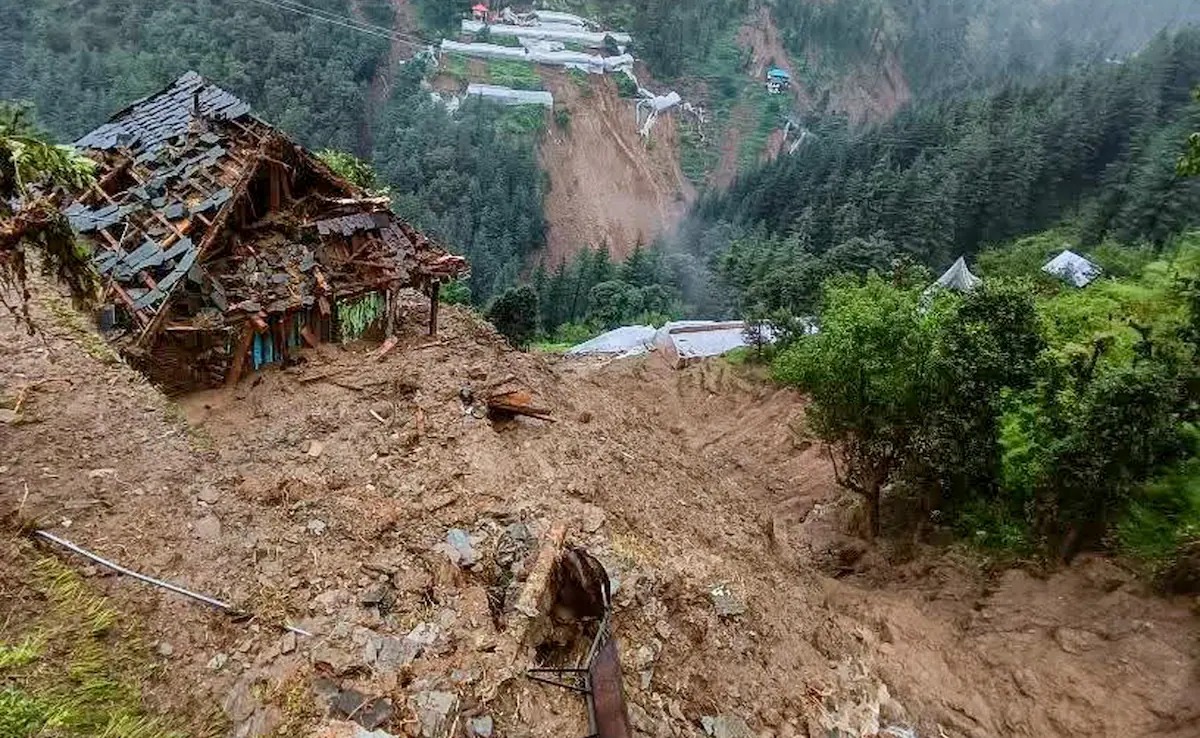
New Delhi: Himachal Pradesh is facing one of its worst monsoon-related disasters in recent years, with at least 63 people confirmed dead and dozens more missing following relentless rainfall, cloudbursts, flash floods, and landslides across the state. The continuous downpour since June 20 has crippled infrastructure, displaced hundreds, and caused widespread panic. The state government has pegged the initial estimate of damages at ₹400 crore, though officials believe the actual figure could be significantly higher.
The district of Mandi has been hit the hardest, accounting for 17 of the reported deaths. Two areas—Thunag and Bagsayed—both falling within the Assembly constituency of former Chief Minister and current Leader of the Opposition, Jairam Thakur, have suffered catastrophic damage. As many as 40 people are missing from Mandi alone, with reports of entire houses being washed away. Other parts of Mandi, including Karsog and Dharampur, have also recorded major destruction.
The scale of the devastation is immense and widespread. Kangra district has reported 13 deaths, followed by Chamba with six and Shimla with five. Fatalities have also been recorded in Bilaspur, Hamirpur, Kinnaur, Kullu, Lahaul-Spiti, Sirmaur, Solan, and Una. Over 100 people have been injured, many of them seriously, as homes collapsed and roads caved in under the pressure of the deluge.
Hundreds of houses have been destroyed or damaged, 14 bridges have been washed away, and nearly 300 livestock, including 164 cattle, have perished. More than 500 roads are currently blocked, cutting off several remote areas from essential supplies. Additionally, over 500 electricity distribution transformers are non-functional, leaving tens of thousands of residents without power. Water and food shortages are emerging as a serious humanitarian crisis.
Terrifying visuals from across the state have flooded social media. Videos show angry rivers swollen with muddy waters tearing through valleys and sweeping away anything in their path. A particularly chilling clip from Dhalli, a suburb of Shimla, shows a massive landslide cascading down a hillside. In the footage, a man filming can be heard shouting warnings to others as a torrent of boulders and earth crashes across a narrow road. The video was later shared by Doordarshan Himachal on X (formerly Twitter), bringing national attention to the scale of the disaster.
“The loss so far has been recorded at ₹400 crore in our system, but actual damage may be much higher,” said D.C. Rana, Special Secretary at the State Disaster Management Authority. “Right now, our primary focus is on search, rescue, and restoration efforts. A detailed damage assessment will take time.”
The Indian Meteorological Department has issued a heavy rain alert for all districts until July 7, raising further concerns for already affected regions. Rescue operations are ongoing, with multiple teams from the National Disaster Response Force (NDRF) and the Army working tirelessly to reach cut-off villages and evacuate stranded families. Helicopters have been deployed for airlifting the injured and delivering essential supplies to inaccessible areas.
Environmental experts have raised red flags about the increasing frequency and severity of such disasters, pointing to unchecked construction, deforestation, and poor urban planning as underlying factors that exacerbate the damage. Calls for better disaster preparedness and climate-resilient infrastructure have grown louder as the hill state stares at yet another monsoon tragedy.
As Himachal Pradesh battles nature’s fury, its residents are left to pick up the pieces of their shattered lives, even as the rain continues to fall. The next few days will be critical as authorities race against time to prevent further loss of life and bring relief to those affected.
Sorry, there was a YouTube error.