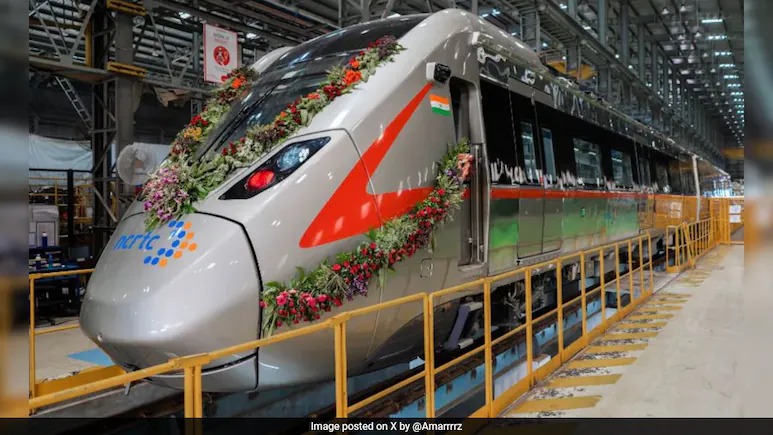
New Delhi: The Namo Bharat train on the Delhi-Meerut Regional Rapid Transit System (RRTS) has emerged as India’s fastest train, reaching speeds of 160 kmph on a 55-km stretch between New Ashok Nagar in East Delhi and Meerut South in Uttar Pradesh. The semi-high-speed train now surpasses the Vande Bharat Express, which currently operates at a maximum of 130 kmph following a speed reduction by the Railway Ministry in June 2024.
Thirty Namo Bharat trainsets, each with six modern coaches, operate at 15-minute intervals from each station along the corridor. The trains achieve their top speed for brief stretches between stations that are farther apart, ensuring swift connectivity across the route.
The full 82.15 km corridor, featuring 16 stations from Sarai Kale Khan in Delhi to Modipuram in Uttar Pradesh, is expected to be fully commissioned soon. Once operational, Namo Bharat will connect Delhi to Meerut in under one hour, while stopping at all enroute stations.
Designed in Hyderabad and manufactured at Alstom’s Savli facility in Gujarat, the aerodynamic trainsets are equipped with Automatic Train Protection (ATP), Automatic Train Control (ATC), and Automatic Train Operations (ATO) systems. Officials noted that the train caters to passengers traveling longer distances with fewer stops, distinguishing it from conventional metro services.
Since the launch of the 17-km priority section on October 21, 2023, operations have steadily expanded, serving over 1.5 crore riders. The NCRTCL emphasized that the system does not follow a fixed timetable or require seat reservations, offering flexibility for commuters.
NCRTCL is also testing a local urban transit service (Meerut Metro) on the same tracks, spanning 23 km with 13 stations. The integration allows commuters to switch seamlessly between the metro and Namo Bharat trains, enhancing convenience and reducing travel time.
The RRTS is being implemented by NCRTCL, a joint venture between the Government of India (50%) and the state governments of Delhi, Uttar Pradesh, Haryana, and Rajasthan (12.5% each). The project marks a milestone in India’s high-speed rail connectivity and regional transport infrastructure.