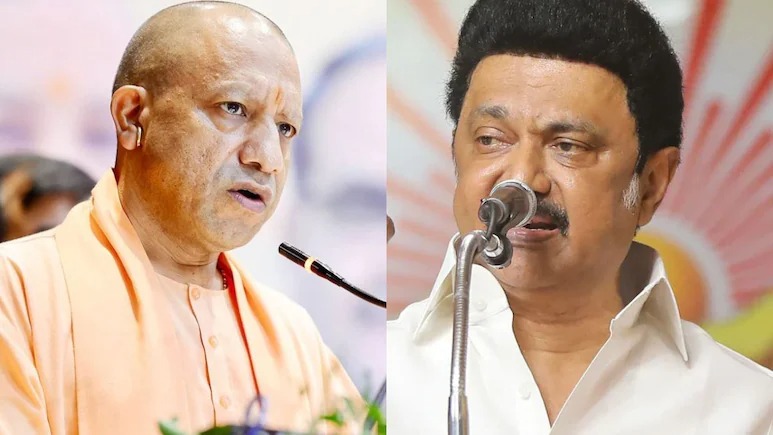
New Delhi: In the latest escalation of the three-language policy debate, tensions between Tamil Nadu and Uttar Pradesh have reached a boiling point. Uttar Pradesh Chief Minister Yogi Adityanath has accused his Tamil Nadu counterpart, MK Stalin, of engaging in “narrow politics” by resisting the policy, which Adityanath believes creates divisions based on region and language. However, Stalin fired back, labeling Adityanath’s remarks as “political black comedy” and defending Tamil Nadu’s stance on language policy as a fight against linguistic imposition rather than opposition to any specific language.
Yogi Adityanath’s accusations against MK Stalin center on the belief that Stalin is using the three-language policy to create divisions. In an interview with ANI, Adityanath stated that Stalin’s opposition to the policy is driven by concerns about his electoral base. Adityanath emphasized that languages should bring people together, not drive them apart, highlighting the importance of national unity.
Moreover, he expressed concerns that Tamil Nadu’s resistance to the three-language policy limits job opportunities for its residents in areas where Hindi is dominant. This has led to a broader discussion on whether language policies should unify or separate regions.
MK Stalin responded vigorously to Adityanath’s accusations, insisting that Tamil Nadu does not oppose any language but resists the imposition of languages and linguistic chauvinism. Stalin’s statement underscores that this is not about politics but a matter of dignity and justice. He noted that Tamil Nadu’s strong stance on a two-language policy and fair delimitation is gaining national attention and unsettling the BJP.
In a separate attack, BJP state president K Annamalai criticized Stalin’s family for owning private schools that teach multiple languages, including Hindi, while opposing the same policy for government schools in Tamil Nadu. This criticism aims to highlight what Annamalai perceives as hypocrisy in Stalin’s stance.
The three-language policy, part of the National Education Policy (NEP) 2020, has been a point of contention between the Centre and several states, particularly Tamil Nadu. Tamil Nadu’s refusal to implement the policy reflects its historical opposition to promoting Hindi at the expense of regional languages.
Sorry, there was a YouTube error.