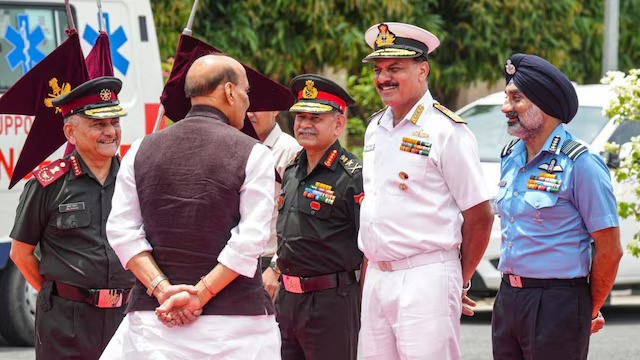
New Delhi: Indian Navy Chief Admiral Dinesh K. Tripathi has underscored a significant shift in India’s security doctrine, declaring that terror attacks will now be treated as acts of war, fundamentally reshaping the Indian Navy’s operational strategy. The change, put into action during Operation Sindoor, represents a bold and assertive approach to national security, especially in the maritime domain.
Speaking at an investiture ceremony at Nausena Bhawan, Admiral Tripathi said this evolved stance has “added a new dimension to our operational outlook.” He emphasized that the Indian Navy’s role is now “more critical than ever” as the country navigates a volatile and rapidly changing global security landscape.
Operation Sindoor was launched following the Pahalgam terror attack on April 22, which claimed the lives of 26 Indian civilians. In response, the Indian armed forces launched a coordinated, multi-domain offensive, with the Navy playing a central role. Admiral Tripathi noted that naval ships, submarines, and aircraft were swiftly deployed to assert India’s maritime strength and deter any retaliation from adversaries—especially along the western front.
“This rapid and measured response not only showcased our strategic reach and maritime dominance but also sent a clear message of resolve, forcing our adversary to plead for a ceasefire, just in time,” he said.
The Navy’s forward posture, coupled with simultaneous precision airstrikes, formed a robust military reaction to cross-border terror. Over the four-day conflict between May 7 and May 10, the Indian Navy’s Western Fleet executed multiple successful firings of surface-to-surface and surface-to-air missiles, as well as torpedoes, from both the western and eastern seaboards.
Following the operation, Defence Minister Rajnath Singh visited INS Vikrant in Goa on May 30 to commend the Navy for its state of readiness and decisive action during the conflict. He noted that within 96 hours of the attack in Pahalgam, the Indian armed forces had demonstrated unmatched responsiveness.
During Operation Sindoor, India conducted precision airstrikes across Pakistan and Pakistan-occupied Kashmir, reportedly eliminating over 100 terrorists. In retaliation, Pakistan launched drone and missile attacks, most of which were successfully intercepted by India’s air defence systems. In a powerful counterstrike on May 10, Indian forces used BrahMos missiles to cripple multiple Pakistani airbases, forcing Islamabad to seek a ceasefire.
India’s Director General of Military Operations (DGMO) was contacted by his Pakistani counterpart on May 10, leading to an agreement to halt military operations. However, India made it clear that Operation Sindoor has only been paused, not concluded, and may resume if provocations continue.
This assertive doctrine marks a turning point in India’s approach to cross-border terrorism. By equating terror strikes with acts of war, India has signalled a new era of strategic deterrence, with the Navy poised to play a vital role in projecting strength and safeguarding national interests across the seas.
Sorry, there was a YouTube error.