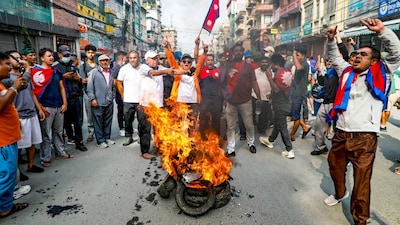
New Delhi: Kathmandu’s streets are burning—with buildings, institutions, and symbols of power engulfed in flames. The parliament building, the Supreme Court, the President’s residence, and even former Prime Minister KP Sharma Oli’s home have been attacked and set on fire. The unrest, largely driven by Gen Z anger, has spiraled into demands far beyond superficial reforms. Protesters are calling for an interim government, claiming that the current political order has collapsed.
A senior government source in Kathmandu, speaking on condition of anonymity, told News18 that divisions are emerging among protesters. “A section is demanding a civilian-led interim government, possibly headed by a former chief justice or a former army chief, comprising Gen Z members and representatives from all political parties. They want elections to be held within six months,” the official said, adding that the situation bears a striking resemblance to the Bangladesh model, where mass protests led to the fall of a civilian regime and ushered in a judiciary-military transition.
However, not all agree on the path forward. “As the violence escalated, the movement turned leaderless. Senior representatives from the army, government, civil society, and political parties are trying to open a dialogue with the protesters,” the official added.
The Nepal army, while consulted, remains cautious. Though it has declared readiness to take control if needed, military leaders prefer a civilian face at the helm of any interim arrangement. The proposal of appointing a former chief justice as head of the interim government is gaining traction, as it offers a neutral figure in a politically fractured environment.
Gopal Khanal, a senior geopolitical commentator and former media adviser to ex-PM Oli, told News18, “Dialogue must be initiated between representatives from the government, army, civil society, and protesters. Whoever controls the interim arrangement will shape Nepal’s future.”
For the protesters, the interim government is not a temporary fix—it is seen as the foundation for a new political contract. The stakes are not merely domestic but geopolitical. India, still recalibrating after the fall of Sheikh Hasina in Bangladesh, is closely watching developments in Nepal, concerned about further instability on its borders.
What is increasingly clear is that the flames engulfing Kathmandu’s power centers have delivered a verdict: the old order is crumbling. The demand for an interim government is no longer a rallying cry—it has become the only roadmap acceptable to the streets. The coming days will determine whether dialogue prevails or chaos deepens.